· H28 · Looksmaxxing · 6 min read
Stubble Wins Where Everyone Else Shaves
The best beard length is partly your jaw and partly whoever is standing next to you.

Heavy stubble is a safe bet for most men, but no beard length is the most attractive one everywhere. In controlled studies, stubble and beards usually beat a bare face, especially for long-term partners. The winner also shifts with how many other men around you have beards, how your jaw looks without one and whether the room is a bar or an interview.
Verdict: Partly.
The clipper video
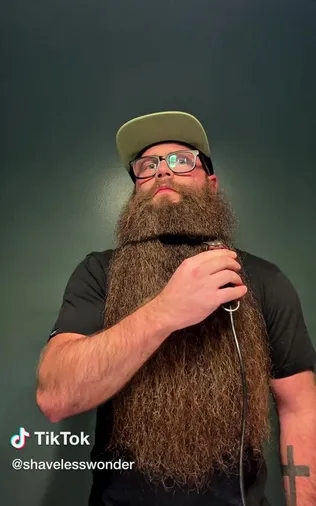
@shavelesswonder had a beard reaching down past his chest. Then he filmed himself taking the clippers to it, captioned it as proof “you don’t need a legendary beard to grow a great one”, and was played 34.5 million times, with 1.37 million likes. Clips like that restart the same argument: beard or no beard, and how much.
You want a stronger-looking face → you grow a beard to cover a soft jaw → people read you as tougher, and spot your smile a little later → what moves it is the length your face and your setting reward.
Why a crowd of beards cheapens yours
In 2014, researchers showed people a run of faces in which beards were either rare or common, then asked them to rate four beard levels (Janif et al., 2014). Heavy stubble and full beards scored higher when beards were rare than when they were everywhere. The reverse held too: a shaved face scored lowest in a sea of shaved faces and gained when it became the odd one out.
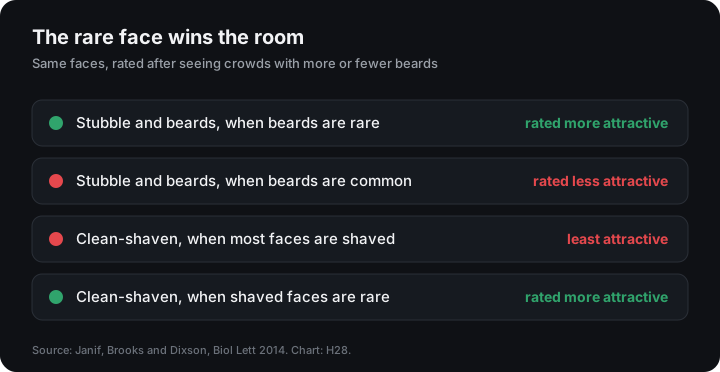
That’s frequency dependence, the same force that keeps some animal colour morphs from ever winning outright. It means the “best” length is partly a fashion cycle. If your whole office grew beards in the lockdown years, a clean shave may now be the stand-out move.
What stubble does to your jaw
A second study morphed male faces to look more or less masculine, then added three levels of facial hair, and had 8,520 women rate them (Dixson et al., 2016). Shaved faces pushed toward either extreme, very masculine or very soft, lost points. Stubble and beards dampened that swing. Facial hair helped ratings for long-term relationships, not for flings.
So a beard works a bit like a filter on bone. It hides a weak chin and blurs a great one.
Coverage matters as much as length. In photos of real men, beards that connected jaw to mustache and filled the cheeks were rated more attractive than patchy ones (Dixson and Rantala, 2016). If yours grows in gaps, keep it short.
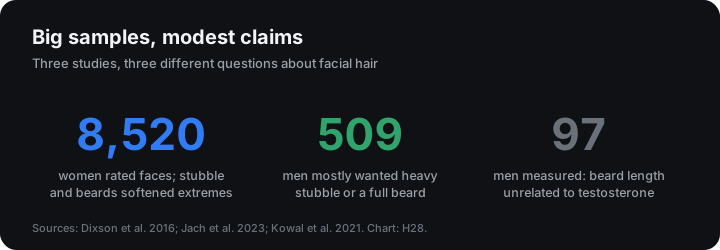
Men seem to know this game. In a survey of 509 men, most wanted heavy stubble or a full beard on themselves, and they valued it more on their own face than on other men’s (Jach et al., 2023).
Tougher, yes. Friendlier, not really.
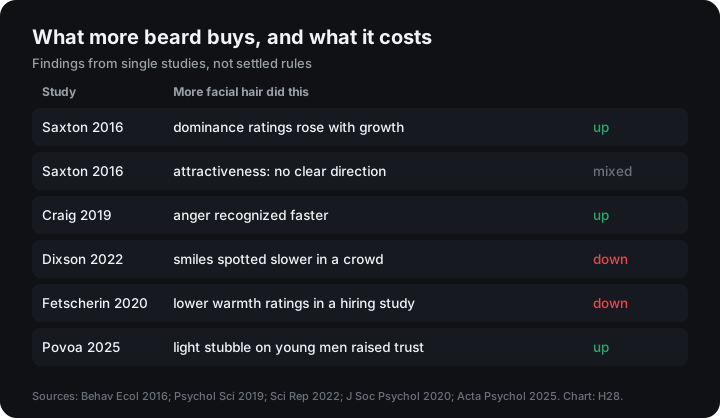
Length changes the message, not just the score. In video clips of men ranging from clean-shaven to a month of growth, dominance ratings climbed steadily with growth, while attractiveness moved in no clear direction (Saxton et al., 2016).
People also spotted anger faster and more accurately on bearded faces, in an experiment with 219 participants (Craig et al., 2019). In crowd search tasks with 419 people, the cost showed up on the other side: happy expressions on bearded faces took longer to detect (Dixson et al., 2022). A hiring study found beards lowered ratings of warmth (Fetscherin et al., 2020), while an economic trust game found light stubble on young men raised trust (Póvoa et al., 2025).
And no, a thick beard is not a testosterone badge. In 97 young men, beard length measured with calipers had no link to testosterone or self-rated dominance (Kowal et al., 2021).
Picking your length
Start at heavy stubble, trimmed at the neckline. It sits between the extremes in every study above, so it rarely loses badly. Go longer if your cheeks fill evenly and your jaw needs cover. Go shorter if it’s patchy, or if the job runs on first-meeting warmth. And check the room: among beards, a bare face stands out. For the wider case on how looks shape treatment, see Pretty Privilege Has Receipts.
FAQ
Do women prefer beards or clean-shaven men? On average, bearded faces get the edge. In one study of 671 women, full beards beat clean-shaven faces, and women with more permissive attitudes to casual sex liked facial hair more (Stower et al., 2020).
Does a patchy beard look worse than no beard? It can. Rated photos favored even growth joining the chin to the mustache, so keeping a thin beard short, or shaving it, often reads better than letting gaps grow out.
Does a beard make you look more masculine? Yes, to observers. Growth pushes up judgments of dominance and aggressiveness, even though beard size says nothing measurable about a man’s hormones.
References
- Janif ZJ, Brooks RC, Dixson BJ. Negative frequency-dependent preferences and variation in male facial hair. Biol Lett. 2014;10(4):20130958. PMID: 24740903. doi:10.1098/rsbl.2013.0958
- Dixson BJ, Sulikowski D, Gouda-Vossos A, Rantala MJ, Brooks RC. The masculinity paradox: facial masculinity and beardedness interact to determine women’s ratings of men’s facial attractiveness. J Evol Biol. 2016;29(11):2311-2320. PMID: 27488414. doi:10.1111/jeb.12958
- Dixson BJ, Rantala MJ. The role of facial and body hair distribution in women’s judgments of men’s sexual attractiveness. Arch Sex Behav. 2016;45(4):877-89. PMID: 26292838. doi:10.1007/s10508-015-0588-z
- Jach Ł, Moroń M, Jonason PK. Men’s facial hair preferences reflect facial hair impression management functions across contexts and men know it. Arch Sex Behav. 2023;52(6):2465-2473. PMID: 37067629. doi:10.1007/s10508-023-02595-6
- Saxton TK, Mackey LL, McCarty K, Neave N. A lover or a fighter? Opposing sexual selection pressures on men’s vocal pitch and facial hair. Behav Ecol. 2016;27(2):512-519. PMID: 27004013. doi:10.1093/beheco/arv178
- Craig BM, Nelson NL, Dixson BJW. Sexual selection, agonistic signaling, and the effect of beards on recognition of men’s anger displays. Psychol Sci. 2019;30(5):728-738. PMID: 30908116. doi:10.1177/0956797619834876
- Dixson BJW, Spiers T, Miller PA, Sidari MJ, Nelson NL, Craig BM. Facial hair may slow detection of happy facial expressions in the face in the crowd paradigm. Sci Rep. 2022;12(1):5911. PMID: 35396450. doi:10.1038/s41598-022-09397-1
- Fetscherin M, Tantleff-Dunn S, Klumb A. Effects of facial features and styling elements on perceptions of competence, warmth, and hireability of male professionals. J Soc Psychol. 2020;160(3):332-345. PMID: 31566087. doi:10.1080/00224545.2019.1671300
- Póvoa ACS, Pech W, Viacava JJC, Korndorfer HB, Jacinto LC. Is beard the male makeup? An experimental study on trust perception based on appearance. Acta Psychol (Amst). 2025;253:104742. PMID: 39848199. doi:10.1016/j.actpsy.2025.104742
- Kowal M, Sorokowski P, Żelaźniewicz A, Nowak J, Orzechowski S, Żurek G, Żurek A, Nawrat M. Are beards honest signals of male dominance and testosterone? Arch Sex Behav. 2021;50(8):3703-3710. PMID: 34676468. doi:10.1007/s10508-021-02012-w
- Stower RE, Lee AJ, McIntosh TL, Sidari MJ, Sherlock JM, Dixson BJW. Mating strategies and the masculinity paradox: how relationship context, relationship status, and sociosexuality shape women’s preferences for facial masculinity and beardedness. Arch Sex Behav. 2020;49(3):809-820. PMID: 31016490. doi:10.1007/s10508-019-1437-2
Cover: screenshot of a TikTok video, shared as commentary.