· H28 · Looksmaxxing · 5 min read
Pretty Privilege Has Receipts. Also Fine Print.
Looks buy a faster first impression. They do not buy everything that comes after it.


Pretty privilege is real: attractive people are judged and treated more kindly, and not only by strangers. A review of 11 meta-analyses found the advantage in children and adults, and even among people who know them well. It is also uneven. Some studies find no pay premium at all, and in one mock trial good looks made a conviction more likely.
Verdict: Real, with limits.
The Walmart experiment
@sarahklait filmed herself counting how many men flirted with her on a Walmart run, captioned it “having pretty privilege isn’t always a good thing”, and collected 4.7 million plays. Videos like it keep reopening the same fight: is pretty privilege obvious, or a story people tell themselves?
The data settles the first half. The effect is well measured. Its size depends a lot on where you’re standing.
You want to be treated better → you chase a sharper jaw → strangers read your whole face in about a second, bone being only part of it → what moves the first impression is the face you walk in with, expression included.
What 11 meta-analyses found
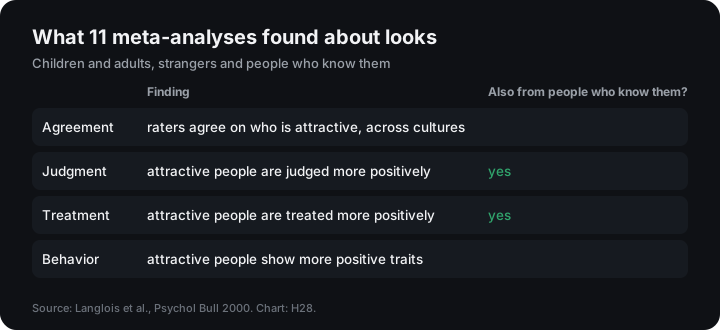
In 2000, psychologists at the University of Texas pooled decades of studies into 11 meta-analyses (Langlois et al., 2000). Four findings came out:
- People agree on who is attractive, within and across cultures.
- Attractive children and adults are judged more positively.
- They are treated more positively.
- They display more positive behaviors and traits themselves.
The second and third held even for people who knew them. That’s the part the “it’s only first impressions” crowd misses: the halo follows you into rooms where people already know your name.
The fourth finding is the interesting one. Being treated well for years may teach confidence, which then looks like a trait you were born with.
One second, one vote
Princeton researchers showed people pairs of congressional candidates’ faces for as little as a second and asked who looked more competent (Todorov et al., 2005). Those snap judgments picked the winner in 68.8% of the 2004 Senate races, and they tracked the margin of victory too.
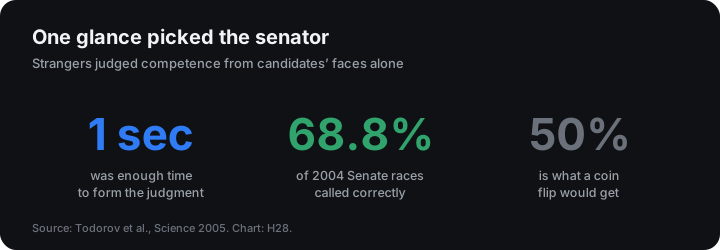
Note what was measured: competence, not beauty. Voters weren’t picking the best-looking candidate; they were reading a trait off the face and trusting it. That matters for looksmaxxing, because a face can look capable without being model-pretty. A rested face also reads healthier to strangers, as we showed in A Bad Week of Sleep Shows on Your Face, and sleep can change this month.
Where the halo flips
The advantage isn’t a flat bonus on everything. Once you leave the lab and look at pay, courtrooms and real conversations, it shrinks, shifts or even reverses.
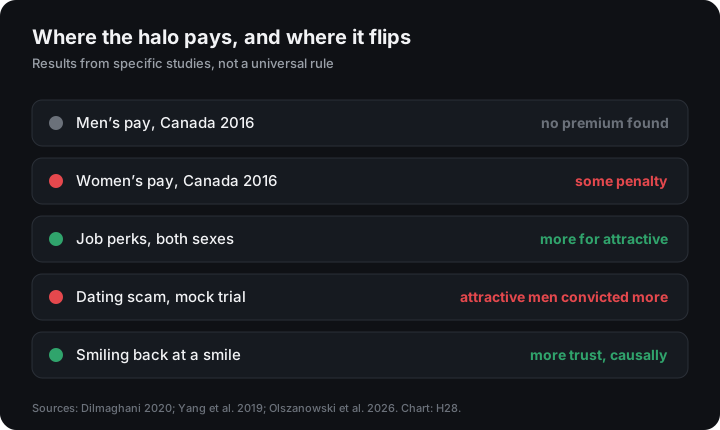
- Pay. Canada’s 2016 General Social Survey found no beauty premium in men’s earnings and some penalty for women, though attractive people of both sexes had more job perks (Dilmaghani, 2020). The ratings were self-reported, which weakens it.
- Court. In a mock trial about a dating scam, women were more likely to find a good-looking man guilty, but only when his face also looked untrustworthy (Yang et al., 2019). Looks that fit the crime counted against him.
- Expression. When viewers mirrored a smiling face, they trusted it more, and blocking that mirroring lowered the effect (Olszanowski et al., 2026). Part of the first impression is movement, not bone.
How to use this without spiralling
- Accept that it’s real. Pretending looks don’t matter makes it harder to act on the parts you can change.
- Remember it’s one input. A second of face gets someone to a guess. Your record, voice and behavior revise it, and people who know you keep revising.
- Spend effort where it moves the read: health, sleep, grooming and an easy expression, before anything drastic.
FAQ
Is pretty privilege scientifically proven? Yes. Pooled research from decades of studies finds a consistent advantage in how good-looking people are rated and handled. How big it is depends on the setting.
Do attractive people earn more? Not reliably. In Canadian survey data, looks didn’t lift men’s wages and slightly hurt women’s, yet better-looking workers of both sexes reported more perks.
Can you get the halo effect without changing your face? Partly. One set of experiments found smiling faces won more trust when viewers smiled back, so expression shapes the impression too.
References
- Langlois JH, Kalakanis L, Rubenstein AJ, Larson A, Hallam M, Smoot M. Maxims or myths of beauty? A meta-analytic and theoretical review. Psychol Bull. 2000;126(3):390-423. PMID: 10825783. doi:10.1037/0033-2909.126.3.390
- Todorov A, Mandisodza AN, Goren A, Hall CC. Inferences of competence from faces predict election outcomes. Science. 2005;308(5728):1623-6. PMID: 15947187. doi:10.1126/science.1110589
- Dilmaghani M. Beauty perks: physical appearance, earnings, and fringe benefits. Econ Hum Biol. 2020;38:100889. PMID: 32485638. doi:10.1016/j.ehb.2020.100889
- Yang Q, Zhu B, Zhang Q, Wang Y, Hu R, Liu S, Sun D. Effects of male defendants’ attractiveness and trustworthiness on simulated judicial decisions in two different swindles. Front Psychol. 2019;10:2160. PMID: 31616349. doi:10.3389/fpsyg.2019.02160
- Olszanowski M, Tołopiło A, Hess U. Smile and the world smiles (and trusts) with you: happiness mimicry shapes first impressions. Emotion. 2026;26(2):495-512. PMID: 41021491. doi:10.1037/emo0001586
Cover: screenshot of a TikTok video, shared as commentary.