· H28 · Protocols · 7 min read
Bimax Moves Bone. Your Lip Pays the Toll.
The one jaw fix that truly moves bone, told with the numbness figures forums skip.


Double jaw surgery, called bimax online, is the rare looksmaxxing move that shifts actual bone, and it works for the people it was built for. In sleep apnea patients it cut breathing pauses by 80% on average, and in people with a mismatched bite the new jaw position mostly holds. The catch is nerve damage: about one in five patients still has a numb patch on the lip or chin a year later.
Verdict: Works, with caveats.
Surgeons cut both jaws free, slide them into a planned spot and fix them with titanium plates. When both jaws travel far forward to open the throat, it’s called maxillomandibular advancement, or MMA.
You want a forward, defined lower face → you learn bimax is the only thing that moves bone → you book it for looks alone → you find it was designed for bites and airways, and its main cost lands on the nerve in your lip.
Who is it actually for?
Two groups. People whose jaws don’t line up, so braces alone can’t make the teeth meet. And adults with obstructive sleep apnea whose airway collapses at night, often after a breathing machine failed.
Braces can’t do this job (Braces Didn’t Push Your Jaw Back), and neither can tongue posture (Mewing After 18 Is a Pose, Not a Jawline).
How well does it fix sleep apnea?
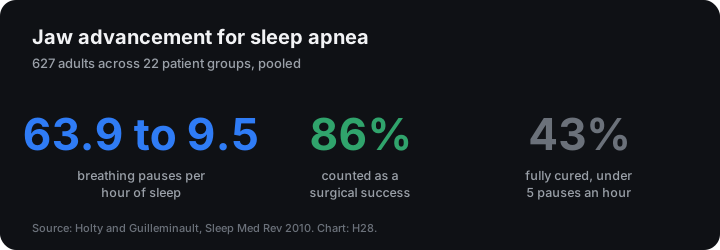
A 2010 meta-analysis pooled 627 adults (Holty and Guilleminault, 2010). Pauses dropped from 63.9 an hour to 9.5; 86% met the usual bar for success and 43% were fully cured. Major complications hit 1.0%, minor ones 3.1%, and nobody died.
A 2016 analysis of 518 patients, many already failed by other airway surgery, found 98.8% improved and 38.5% cured (Zaghi et al., 2016). Cure came easiest below 60 events an hour.
Does it make faces better looking?
Usually. In one crowdsourced study, 500 strangers rated 20 long-faced patients before and after bimax plus chin work, and judged them more attractive, trustworthy and intelligent afterward (Posnick and Kinard, 2019). A review of five such studies agreed, yet in most traits the patients still fell short of people born with a normal bite (Mugnier et al., 2020).
Apnea patients get a bigger push, chosen for the airway, not for looks. Of 42 who noticed a change, 24 liked it and 4 thought they looked worse (Li et al., 2001). Eight of 26 British patients rated their face lower afterward (Islam et al., 2015).
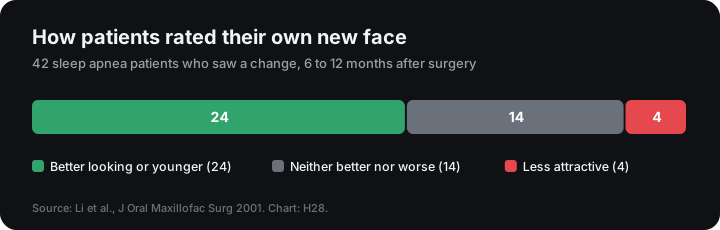
Satisfaction tends to last. In 126 bimax patients followed three years or more, it stayed high, and complications were the main thing dragging it down (Talpoș et al., 2026).
What goes wrong?
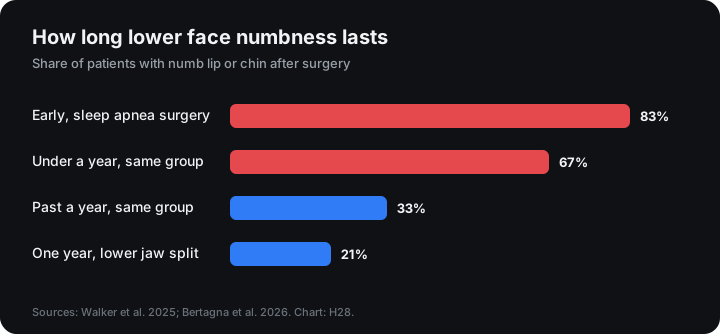
The numb lip. The lower jaw split runs past the nerve that gives feeling to your lower lip and chin. Across 47 studies and 5,406 patients, 21% still had altered sensation at one year, more often with older age and bigger moves (Bertagna et al., 2026). After apnea surgery, numbness appeared early in 83% and lingered past a year in 33% (Walker et al., 2025).
Then the hardware. In a Swedish registry of 428 patients, lower jaw or double jaw surgery carried over three times the risk of infection, plate removal and numbness seen with upper jaw work alone (Pekkari et al., 2025). A UK unit removed or adjusted plates after 10.7% of 429 operations and needed 12 revisions (Shammout et al., 2026). Relapse looks rare when both jaws move to bring a small lower jaw forward, though the evidence is thin (Eckmüller et al., 2022).
One twist for looksmaxxers: after bite surgery, 12.25% of patients developed sleep apnea (Kassir et al., 2026). A face plan that ignores the airway can cost you sleep.
Where to start
If you snore, wake tired or your teeth don’t meet, see an oral and maxillofacial surgeon alongside a sleep doctor or orthodontist. If you want it purely for looks, know that pooled studies found signs of body dysmorphic disorder in about 14.5% of people seeking jaw surgery (Sáenz-Ravello et al., 2025). Be honest with yourself first.
FAQ
Is double jaw surgery only cosmetic? No. Its main jobs are fixing jaws that don’t meet and widening a collapsing airway; the new look rides along.
How long does recovery take? Pooled studies put the operation near five and a half hours and the hospital stay near three days (Kassir et al., 2026). Swelling takes months, and feeling can keep returning past a year.
Can you get MMA without having sleep apnea? MMA is planned around breathing. If your teeth meet fine and you breathe well at night, there’s usually little medical reason for it, and a good surgeon will say so.
References
- Holty JE, Guilleminault C. Maxillomandibular advancement for the treatment of obstructive sleep apnea: a systematic review and meta-analysis. Sleep Med Rev. 2010;14(5):287-97. PMID: 20189852. doi:10.1016/j.smrv.2009.11.003
- Zaghi S, Holty JE, Certal V, et al. Maxillomandibular Advancement for Treatment of Obstructive Sleep Apnea: A Meta-analysis. JAMA Otolaryngol Head Neck Surg. 2016;142(1):58-66. PMID: 26606321. doi:10.1001/jamaoto.2015.2678
- Posnick JC, Kinard BE. Orthognathic Surgery Has a Significant Positive Effect on Perceived Personality Traits and Perceived Emotional Expressions in Long Face Patients. J Oral Maxillofac Surg. 2019;77(2):408.e1-408.e10. PMID: 30414945. doi:10.1016/j.joms.2018.10.005
- Mugnier J, Ibrahim B, Bouletreau P, Sigaux N. The influence of orthognathic surgery on the perception of personality traits: A scoping review. Int J Oral Maxillofac Surg. 2020;49(10):1294-1302. PMID: 32376076. doi:10.1016/j.ijom.2020.03.017
- Li KK, Riley RW, Powell NB, Guilleminault C. Patient’s perception of the facial appearance after maxillomandibular advancement for obstructive sleep apnea syndrome. J Oral Maxillofac Surg. 2001;59(4):377-80. PMID: 11289166. doi:10.1053/joms.2001.21870
- Islam S, Aleem F, Ormiston IW. Subjective assessment of facial aesthetics after maxillofacial orthognathic surgery for obstructive sleep apnoea. Br J Oral Maxillofac Surg. 2015;53(3):235-8. PMID: 25542284. doi:10.1016/j.bjoms.2014.11.018
- Talpoș Ș, Loloș D, Hajaj T, et al. Long-term patient satisfaction and complication rates after orthognathic surgery: a minimum 3-year follow-up study. Oral Maxillofac Surg. 2026;30(1):92. PMID: 42191967. doi:10.1007/s10006-026-01580-2
- Bertagna AE, Van der Cruyssen F, Miloro M. Persistent Neurosensory Disturbance Following Sagittal Split Osteotomy: A Systematic Review and Meta-Analysis of One-Year Outcomes and Risk Factors. J Oral Maxillofac Surg. 2026;84(1):25-44. PMID: 40983111. doi:10.1016/j.joms.2025.08.014
- Walker A, Kassir MF, Sama V, Nguyen SA, Abdelwahab M. Maxillomandibular Advancement Safety and Effectiveness in Obstructive Sleep Apnea: Systematic Review and Meta-Analysis. Otolaryngol Head Neck Surg. 2025;172(4):1142-1154. PMID: 39764681. doi:10.1002/ohn.1114
- Pekkari C, Weiner CK, Salinas Fredricson A, et al. Factors associated with postoperative complications after orthognathic surgery: a National Swedish register-based cohort study. Oral Maxillofac Surg. 2025;30(1):5. PMID: 41339970. doi:10.1007/s10006-025-01493-6
- Shammout M, Abdullah J, Shammout A, Williams R, Mcmillan K. A call for fixed standards: a decade of orthognathic surgery, biting into revision rates and metalwork removal. Br J Oral Maxillofac Surg. 2026;64(6):457-463. PMID: 42055829. doi:10.1016/j.bjoms.2026.03.011
- Eckmüller S, Paddenberg E, Hiller KA, et al. Relapse in class II orthognathic surgery: a systematic review. BMC Oral Health. 2022;22(1):605. PMID: 36517840. doi:10.1186/s12903-022-02636-x
- Kassir MF, Walker A, Howser LA, et al. Comparative Meta-Analysis of Complications of Maxillomandibular Advancement for OSA versus Orthognathic Surgeries for Dentofacial Deformities. Otolaryngol Head Neck Surg. 2026. PMID: 42529894. doi:10.1002/ohn.70352
- Sáenz-Ravello G, Carrasco García P, Fan S, Al-Nawas B. Prevalence of Body Dysmorphic Disorder in Patients Seeking Orthognathic Surgery: A Systematic Review and Meta-Analysis. J Oral Maxillofac Surg. 2025;83(11):1351-1362. PMID: 40782826. doi:10.1016/j.joms.2025.07.003
Cover: screenshot of a TikTok video, shared as commentary.