· H28 · Protocols · 6 min read
Needles Make Minoxidil Hit Harder
A roller with tiny spikes, once a week, beat the bottle on its own in trial after trial.


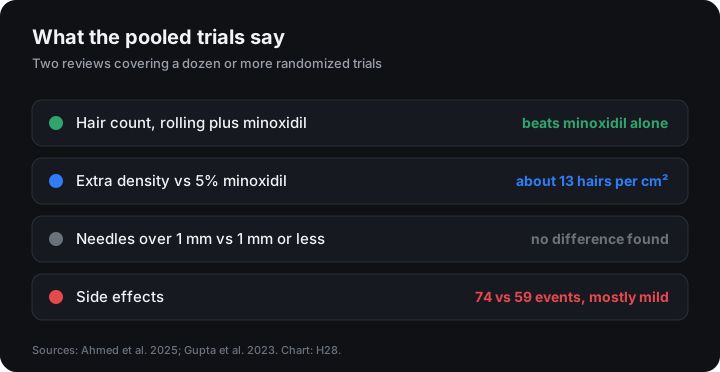
Microneedling added to minoxidil grows more hair than minoxidil by itself, and that result has now repeated across a dozen randomized trials. A 2023 network analysis put the gain at about 13 hairs per square centimeter over 5% minoxidil alone. It’s an add-on to a drug that already works, not a replacement for one.
Verdict: Works, with caveats.
A roller and a bottle
@al_garrido’s video on using minoxidil and a derma roller together sits at 7.2 million views. The trials behind the trend are real, and calmer than the roller aisle suggests.
You want thicker hair on top → you roll your scalp every night with the longest needles you can find → you get sore skin and a door open for infection → the tested version is one session a week, moderate needles, minoxidil kept off fresh wounds.
The trial that started it
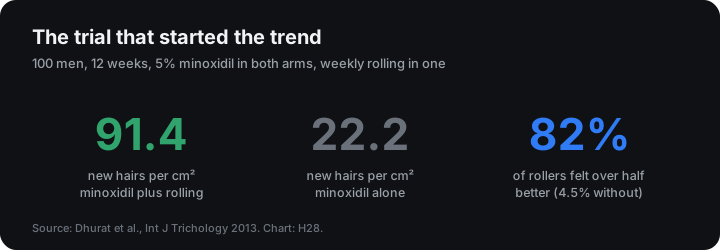
In 2013, dermatologists in Mumbai split 100 men with mild to moderate pattern loss into two groups (Dhurat et al., 2013). Both used 5% minoxidil twice a day. One group also had a 1.5 mm dermaroller run over the thinning area once a week, until the skin turned mildly red.
After 12 weeks, a tattooed patch of scalp told the story. The rolling group averaged 91.4 new hairs in that square centimeter, the minoxidil group 22.2. Regrowth showed up at around week 6 with needles and week 10 without.
Two years later the same team treated four men who had been on finasteride and minoxidil for two to five years without new growth (Dhurat and Mathapati, 2015). Six months of sessions gave all four visible regrowth, still there at 18 months. Four men is an anecdote with a methods section, but it hints at who gains most: the stuck responder.
Did it hold up?
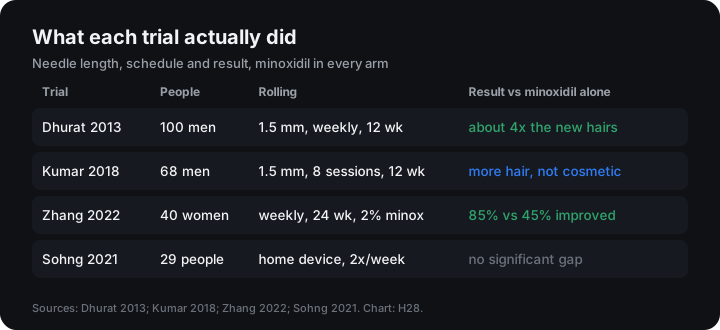
Mostly. A 2018 trial of 68 men used the same 1.5 mm roller, this time until pinpoint bleeding. Combined treatment again won on hair count, though the authors wrote plainly that the gain was not cosmetically significant (Kumar et al., 2018). In 40 women on 2% minoxidil, weekly needling lifted the response rate from 45% to 85% over 24 weeks (Zhang et al., 2022).
A 2025 meta-analysis pooled 12 randomized trials covering 631 people (Ahmed et al., 2025). Rolling plus minoxidil beat minoxidil on hair count and on shaft thickness. A network analysis of 27 trials ranked the pair first of six options for density (Gupta et al., 2023).
The catch: trial sizes vary wildly, and many are small and short. Direction is solid. The exact payoff isn’t.
Deeper isn’t better
The same 2025 review split the trials by needle depth. Needles longer than 1 mm and needles of 1 mm or less gave statistically indistinguishable results, and rollers did as well as powered devices. Longer needles bought nothing measurable.
Frequency is the other detail worth copying. The positive trials above rolled once a week or less, in a clinic. A Korean home device used twice weekly for six months showed a trend toward more hair, but it missed statistical significance (Sohng et al., 2021).
Where it goes wrong
In the trials, most side effects were redness, itch and soreness. The pooled count was 74 events with rolling against 59 without, mostly mild or short-lived (Ahmed et al., 2025).
A review of 85 microneedling papers adds the rarer, lasting problems: dark marks, tram-track scars and granuloma-type reactions, with active infection, darker skin, metal allergy and putting non-injectable products into fresh punctures as risk factors (Chu et al., 2021). Both 1.5 mm trials also had patients skip minoxidil on rolling day and restart it 24 hours later.
A bathroom session skips the antiseptic scalp prep the trials used, and the trained eye that spots trouble early.
Where we’d start
Sort the drug side first; see Finasteride Is a Two-Year Drug for why the drugs do the heavy lifting. Plateaued? Ask a dermatologist about in-office needling, which is what was tested. And skip the rosemary detour (Rosemary Oil Only Tied the Weaker Minoxidil).
FAQ
Can I microneedle my scalp without minoxidil? Alone it ranked near the bottom in the network analysis, behind plain 5% minoxidil. The benefit shows up as a partner to a drug.
How long until microneedling shows results for hair? In the first trial, new growth appeared at about six weeks. That trial judged the result at week 12.
Is a 0.5 mm roller enough? Short needles weren’t worse than long ones in the pooled trials, but a cosmetic 0.5 mm roller wasn’t what most studies tested. Ask a dermatologist before settling on one.
References
- Dhurat R, Sukesh M, Avhad G, et al. A randomized evaluator blinded study of effect of microneedling in androgenetic alopecia: a pilot study. Int J Trichology. 2013;5(1):6-11. PMID: 23960389. doi:10.4103/0974-7753.114700
- Dhurat R, Mathapati S. Response to microneedling treatment in men with androgenetic alopecia who failed to respond to conventional therapy. Indian J Dermatol. 2015;60(3):260-3. PMID: 26120151. doi:10.4103/0019-5154.156361
- Kumar MK, Inamadar AC, Palit A. A randomized controlled, single-observer blinded study to determine the efficacy of topical minoxidil plus microneedling versus topical minoxidil alone in the treatment of androgenetic alopecia. J Cutan Aesthet Surg. 2018;11(4):211-216. PMID: 30886475. doi:10.4103/JCAS.JCAS_130_17
- Zhang Y, Sheng Y, Zeng Y, et al. Randomized trial of microneedling combined with 2% minoxidil topical solution for the treatment of female pattern hair loss in a Chinese population. J Cosmet Dermatol. 2022;21(12):6985-6991. PMID: 36214061. doi:10.1111/jocd.15424
- Ahmed KMA, Kozaa YA, Abuawwad MT, et al. Evaluating the efficacy and safety of combined microneedling therapy versus topical minoxidil in androgenetic alopecia: a systematic review and meta-analysis. Arch Dermatol Res. 2025;317(1):528. PMID: 40056230. doi:10.1007/s00403-025-04032-1
- Gupta AK, Wang T, Bamimore MA, et al. Relative effects of minoxidil 5%, platelet-rich plasma, and microneedling in pattern hair loss: a systematic review and network meta-analysis. Skin Appendage Disord. 2023;9(6):397-406. PMID: 38058547. doi:10.1159/000534196
- Sohng C, Lee EH, Woo SK, et al. Usefulness of home-use microneedle devices in the treatment of pattern hair loss. J Cosmet Dermatol. 2021;20(2):591-596. PMID: 32516497. doi:10.1111/jocd.13540
- Chu S, Foulad DP, Atanaskova Mesinkovska N. Safety profile for microneedling: a systematic review. Dermatol Surg. 2021;47(9):1249-1254. PMID: 34448760. doi:10.1097/01.DSS.0000790428.70373.f6
Cover: screenshot of a TikTok video, shared as commentary.