· H28 · Myths · 5 min read
Rosemary Oil Only Tied the Weaker Minoxidil
One six-month study, a 2% rival and no placebo. That is the entire case.


Rosemary oil has not been shown to work as well as minoxidil for pattern hair loss. The whole claim rests on one 2015 trial of 100 people, which found rosemary oil and 2% minoxidil grew about the same amount of hair after six months. There was no placebo group, and 2% is the weaker strength; the 5% dose regrows far more.
Verdict: Unproven.
A scalp ritual with 26 million plays
A hair-oiling video from @tessapeay, tagged #rosemaryoil, has 26 million plays and 1.2 million likes. Her next one, a rosemary water recipe, warns you to make it only if you’re ready for hair that “grows like weeds”. Behind the trend sits one line from the research: rosemary matched minoxidil.
That line is technically true. It just leaves out which minoxidil, for how long, and against what.
You want thicker hair at the temples → you massage rosemary oil in every night → the only trial behind it compared it with a weak dose and no placebo → what moves pattern hair loss is the drugs with years of controlled data behind them.
The one trial everyone cites
Researchers split 100 people with pattern hair loss into two groups of 50: one rubbed in rosemary oil, the other 2% minoxidil, for six months (Panahi et al., 2015). Hair was counted from standardized close-up photos.
At three months, neither group had gained anything. At six months, both had more hair than at the start, and the gap between them was too small to matter statistically. Scalp itching went up in both groups, more often with minoxidil.
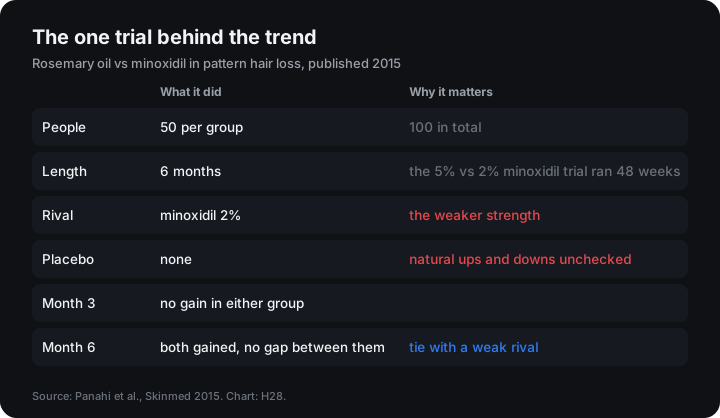
Three problems sit inside that result.
No placebo. Hair counts drift with seasons, shedding cycles and how the photos are taken. Without an untreated group, “both went up” could partly be noise.
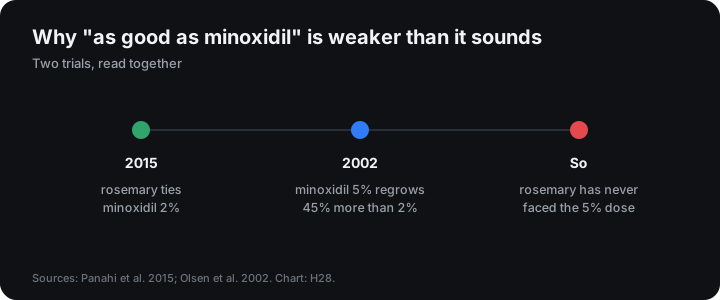
A soft rival. 2% is the milder minoxidil. Tested head to head over 48 weeks, the 5% dose regrew 45% more hair than 2%, and sooner (Olsen et al., 2002). Tying the 2% is a tie with the understudy.
One study. It hasn’t been repeated in a larger, placebo-controlled trial. A 2024 review of natural hair-loss remedies still lists only finasteride and minoxidil as FDA-approved and calls for more research on the herbal options (Bin Rubaian et al., 2024).
Where rosemary did beat a control
There is one older result worth knowing. In 1998, Scottish dermatologists gave 86 people with alopecia areata, the patchy autoimmune kind of hair loss, a daily scalp massage (Hay et al., 1998). Half used a blend of thyme, rosemary, lavender and cedarwood oils in a carrier oil; the other half used the carrier oil alone.
After seven months, 44% of the essential-oil group had improved, against 15% of the carrier group. It was randomized and double-blind.
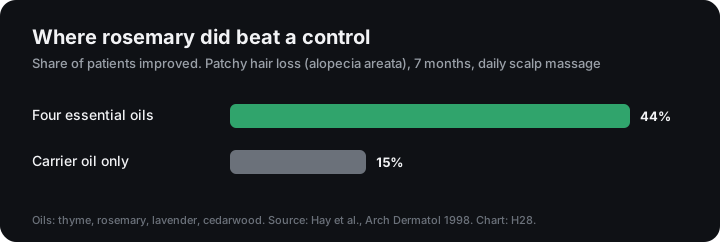
It’s a different disease from the receding hairline and thinning crown most people are fighting, and rosemary was one of four oils in the bottle. It shows oils can do something on a scalp. It says nothing about DHT, the hormone that shrinks follicles in pattern loss.
What we’d put on the scalp instead
Against DHT-driven thinning, the proven pair is still finasteride and 5% minoxidil, and both need a year before you judge them. We walked through their timelines in Finasteride Is a Two-Year Drug.
If you like oiling, keep it as a ritual:
- Patch test first. Essential oils irritate some scalps, and an itchy, inflamed scalp won’t help anything grow.
- Don’t swap it for a drug that works. Every month on an untested oil during active shedding is a month of follicles you may not get back.
- Use it alongside, if at all. Nothing here suggests rosemary oil interferes with minoxidil.
- Photograph your crown monthly, same light and angle, so you’re judging hair and not memory.
FAQ
Is rosemary oil as good as minoxidil? Only against the 2% strength, in one six-month trial with no placebo group. It has never been compared with 5% minoxidil.
How long does rosemary oil take to work on hair? In the one trial, neither rosemary oil nor 2% minoxidil showed any gain at three months. Both groups had more hair at six months.
Can rosemary oil stop a receding hairline? No trial has shown it can. Receding from DHT is what finasteride is proven to slow.
References
- Panahi Y, Taghizadeh M, Marzony ET, Sahebkar A. Rosemary oil vs minoxidil 2% for the treatment of androgenetic alopecia: a randomized comparative trial. Skinmed. 2015;13(1):15-21. PMID: 25842469.
- Olsen EA, Dunlap FE, Funicella T, et al. A randomized clinical trial of 5% topical minoxidil versus 2% topical minoxidil and placebo in the treatment of androgenetic alopecia in men. J Am Acad Dermatol. 2002;47(3):377-85. PMID: 12196747. doi:10.1067/mjd.2002.124088
- Bin Rubaian NF, Alzamami HFA, Amir BA. An overview of commonly used natural alternatives for the treatment of androgenetic alopecia, with special emphasis on rosemary oil. Clin Cosmet Investig Dermatol. 2024;17:2495-2503. PMID: 39524109. doi:10.2147/CCID.S470989
- Hay IC, Jamieson M, Ormerod AD. Randomized trial of aromatherapy: successful treatment for alopecia areata. Arch Dermatol. 1998;134(11):1349-52. PMID: 9828867. doi:10.1001/archderm.134.11.1349
Cover: screenshot of a TikTok video, shared as commentary.