· H28 · Protocols · 5 min read
Finasteride Is a Two-Year Drug
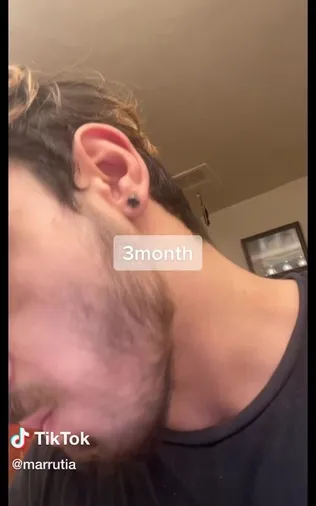
Most men quit at month three. The trials only got good after that.

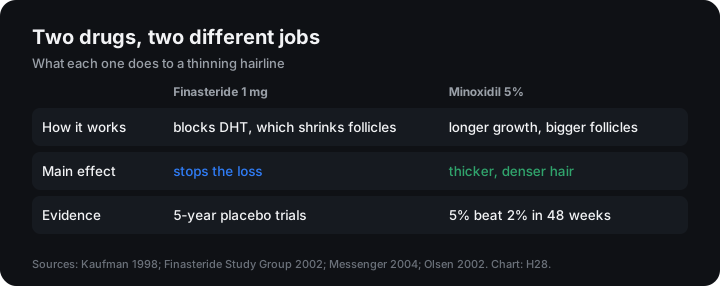
Finasteride and minoxidil work, but on a timescale of years, not weeks, and they do different jobs. Finasteride stops the hormone that shrinks hair follicles, and in the big trials it was still adding hair in year two and holding it at year five. Minoxidil thickens what’s there by making follicles grow longer and larger. Used together, 94% of men improved in a year, against 59% on minoxidil alone.
Verdict: Works, if you give it time.
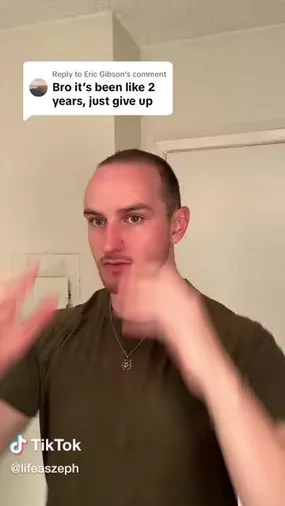
The most common mistake is judging finasteride at month one or two. You don’t see much, you decide it’s a scam, you quit, and the hairline keeps going. The trials say the first fair verdict comes at one year.
You want your hairline back → you start finasteride and check the mirror every week → nothing obvious happens for months, so you quit → the loss you stopped comes back, when the drug needed another year to show what it does.
Why hair thins in the first place
Male pattern hair loss is driven by DHT, a hormone made from testosterone. In men who are sensitive to it, DHT makes the follicles at the top of the head and the hairline shrink a little with every cycle. The hairs come back thinner and shorter until some stop showing at all.
That’s why two drugs make sense: one takes away the signal doing the shrinking, the other pushes follicles to grow.
Finasteride: slow, then steady
Finasteride 1 mg lowers DHT in the scalp. In two year-long trials with 1,553 men, it beat placebo on every measure: hair counts, photos judged by experts and the men’s own opinion (Kaufman et al., 1998).
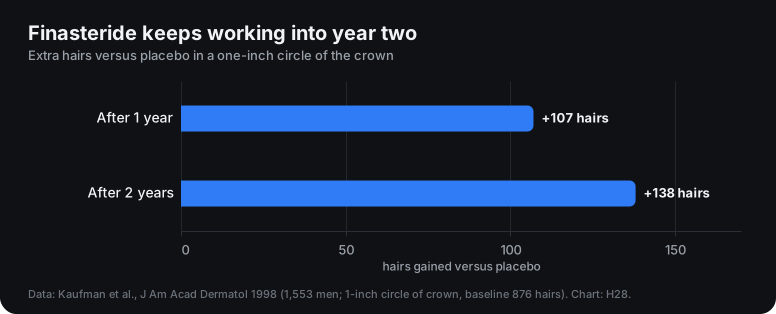
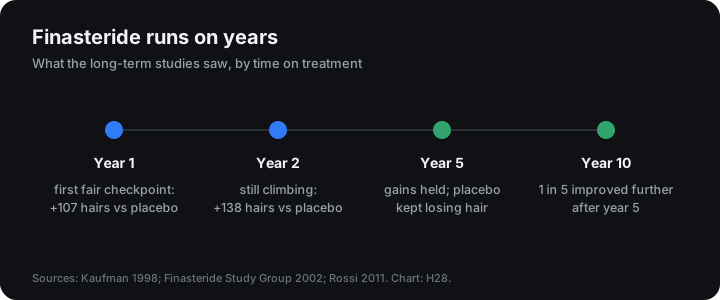
In a one-inch circle of the crown, where the average man started with 876 hairs, finasteride users had 107 more hairs than placebo after one year and 138 more after two. The men on placebo kept losing hair.
Those trials were extended to five years. The improvements held the whole time, while the placebo group’s hair kept thinning (Finasteride Male Pattern Hair Loss Study Group, 2002).
An Italian study followed 118 men for ten years. It found the first year was the best predictor of how someone would respond, but many men who looked unchanged at twelve months improved later, and 21% got better results by continuing beyond five years (Rossi et al., 2011).
Minoxidil: the thickener
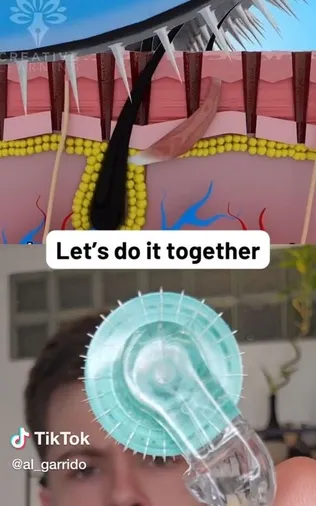
Minoxidil works differently. It pushes resting follicles back into their growth phase, keeps them growing longer and can make the follicles themselves larger, which turns thin hairs into thicker ones (Messenger and Rundegren, 2004).
Strength matters. In a 48-week trial of 393 men, 5% minoxidil beat both 2% and placebo, and it worked faster than 2% (Olsen et al., 2002). The cost was more itching and scalp irritation.
Together
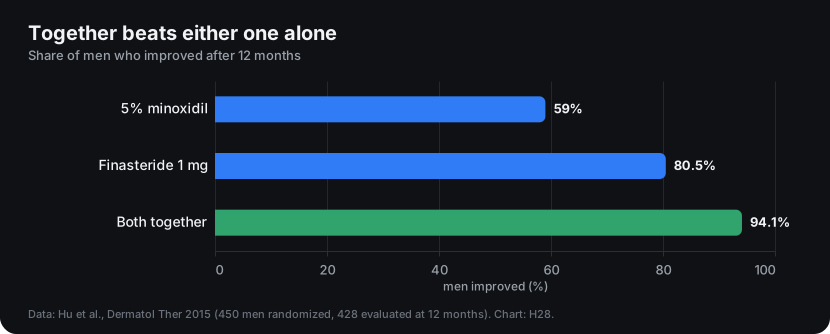
A study that randomized 450 men compared finasteride, 5% minoxidil and both together for a year. Improvement came in 59% of the minoxidil group, 80.5% of the finasteride group and 94.1% of those using both (Hu et al., 2015). Side effects were uncommon and went away when the drugs were stopped.
What to expect on the Norwood scale
These drugs protect what you have and add density. They won’t turn an advanced hairline back into a teenage one. In the Kaufman trial, a gain of 138 hairs on a base of 876 is a real, visible thickening of the crown, not a new hairline. The earlier you start, the more hair there is left to keep.
What we’d tell a friend
See a doctor, because finasteride is a prescription drug and side effects, though uncommon, are real. Take photos in the same light every three months. Don’t judge anything before a year. If it’s working, the plan is to keep taking it, because stopping lets DHT start shrinking follicles again.
FAQ
How long does finasteride take to work? Plan on a full year before judging it. In the major trials, hair counts were still rising at two years, and benefits held for five and ten years.
Is minoxidil or finasteride better? Neither replaces the other: one removes the hormone behind the thinning, the other grows thicker strands. In a head-to-head trial finasteride helped more men, and the two together helped the most.
Can these drugs regrow a hairline? Mostly they halt further loss and add thickness, with the crown responding best. Expect more density, not a hairline from ten years ago.
References
- Kaufman KD, Olsen EA, Whiting D, et al. Finasteride in the treatment of men with androgenetic alopecia. J Am Acad Dermatol. 1998;39(4 Pt 1):578-89. PMID: 9777765. doi:10.1016/s0190-9622(98)70007-6
- Finasteride Male Pattern Hair Loss Study Group. Long-term (5-year) multinational experience with finasteride 1 mg in the treatment of men with androgenetic alopecia. Eur J Dermatol. 2002;12(1):38-49. PMID: 11809594.
- Rossi A, Cantisani C, Scarnò M, et al. Finasteride, 1 mg daily administration on male androgenetic alopecia in different age groups: 10-year follow-up. Dermatol Ther. 2011;24(4):455-61. PMID: 21910805. doi:10.1111/j.1529-8019.2011.01441.x
- Messenger AG, Rundegren J. Minoxidil: mechanisms of action on hair growth. Br J Dermatol. 2004;150(2):186-94. PMID: 14996087. doi:10.1111/j.1365-2133.2004.05785.x
- Olsen EA, Dunlap FE, Funicella T, et al. A randomized clinical trial of 5% topical minoxidil versus 2% topical minoxidil and placebo in the treatment of androgenetic alopecia in men. J Am Acad Dermatol. 2002;47(3):377-85. PMID: 12196747. doi:10.1067/mjd.2002.124088
- Hu R, Xu F, Sheng Y, et al. Combined treatment with oral finasteride and topical minoxidil in male androgenetic alopecia: a randomized and comparative study in Chinese patients. Dermatol Ther. 2015;28(5):303-8. PMID: 26031764. doi:10.1111/dth.12246
Cover: screenshot of a TikTok video, shared as commentary.