· H28 · Myths · 5 min read
Your Creatine Scoop Isn't Taking Your Hairline
One rugby blood test started a rumor. The first scalp trial never backed it up.


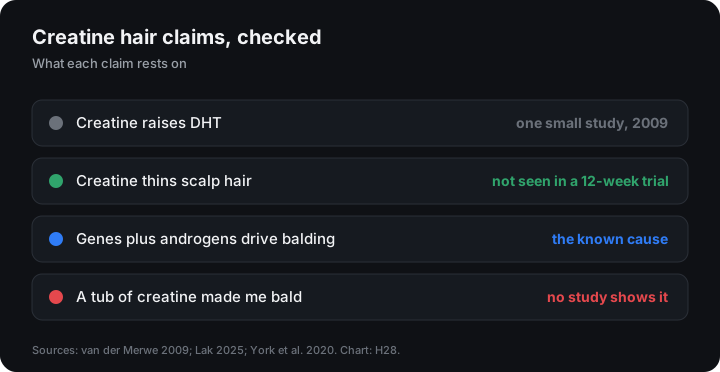
Creatine has never been shown to cause hair loss: the one randomized trial that actually measured scalp hair found no difference between creatine and placebo after 12 weeks. The fear started with a 2009 study of 20 rugby players whose DHT, the hormone behind male pattern balding, rose during creatine loading. That study took blood, not hair counts, and its hormone result has never been replicated.
Verdict: Doesn’t, on the evidence we have.
Where the scare comes from
“I Took Creatine For 2 Months So You Didn’t Have To (Results: Hair Loss, Acne)” sits over a clip from @nunoliftz with over 5 million plays and 340,000 likes. It’s among the most-liked TikToks you get when you search the topic.
Fair enough. Your hairline is not something you want to gamble on for a few extra reps. But a two-month personal story can’t separate creatine from the thing that usually thins hair in young men: their own genes.
You want to look bigger and keep your hair → you start creatine and spot more strands in the shower drain → it caused panic, not balding → what moves your hairline is your DHT sensitivity, and the drugs that target it.
What the rugby study actually found
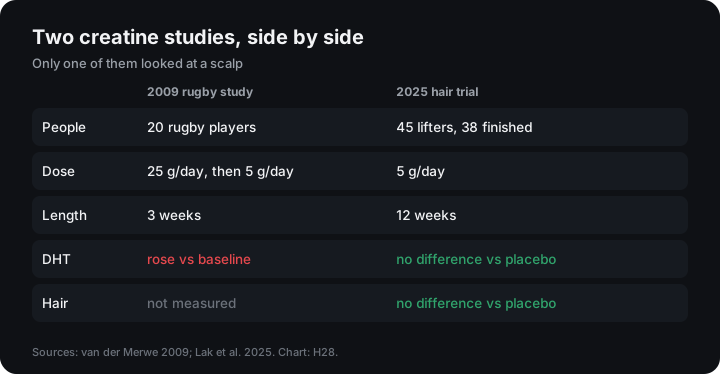
Researchers in South Africa gave 20 college rugby players creatine or placebo in a crossover design. Each player loaded 25 grams daily for a week, then dropped to 5 grams for two more weeks (van der Merwe et al., 2009).
Testosterone stayed flat. DHT did not: it climbed 56% after the loading week and was still 40% above baseline after the maintenance phase. The ratio of DHT to testosterone rose too.
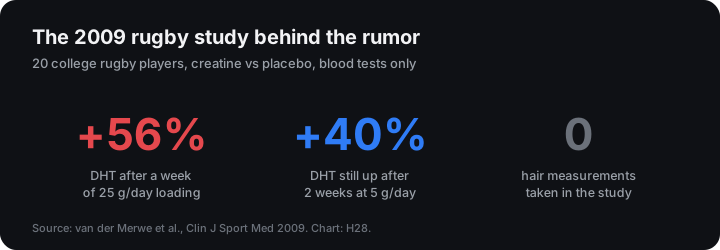
That sounds bad until you notice what’s missing. No one counted hairs, photographed a crown or looked at a follicle. The authors themselves said the long-term safety question needed more work. The internet skipped that part and wrote “creatine makes you bald.”
The trial that looked at the scalp
In 2025 a group finally measured the thing everyone was worried about. Forty-five resistance-trained men aged 18 to 40 took 5 grams of creatine or a maltodextrin placebo every day for 12 weeks. Thirty-eight finished (Lak et al., 2025).
Hair was checked with a trichogram and a FotoFinder scalp camera: density, follicular unit count and total hair thickness. Blood was tested for testosterone, free testosterone and DHT.
Nothing separated the groups. DHT, the DHT to testosterone ratio and every hair measure moved the same way on creatine as on placebo.
Two honest caveats. Twelve weeks is short for hair, and several authors advise creatine brands or run a sports nutrition society funded partly by supplement companies. Still, it’s the only scalp data in existence, and it points one way. A 2021 review by creatine researchers, with similar industry ties, added two things: the rugby result was never replicated, and hard lifting on its own can push these androgens up (Antonio et al., 2021).
So why does the hair seem to go?
Male pattern hair loss runs on genetics and androgens, and it progresses over time whatever else you’re doing (York et al., 2020). So whatever you started the month the drain looked fuller gets the blame. Timing makes a convincing villain.
If your dad and uncles thinned early, creatine was never the plot. For what actually slows it, see Finasteride Is a Two-Year Drug.
The sensible move
Take your 3 to 5 grams. Skip the 25-gram loading week if hormones worry you: that’s the dose where the DHT bump showed up, and the 2021 review notes that 3 to 5 grams a day fills your muscles fine without it. If you’re genuinely thinning, stopping creatine won’t rescue anything: book a dermatologist and photograph your crown under one lamp each season.
FAQ
Does creatine increase DHT? One 2009 trial in 20 rugby players saw it rise during a high-dose loading phase. The 2025 trial at 5 grams daily found DHT on creatine matched placebo.
Should I quit creatine if my hair is thinning? Quitting is unlikely to change your hair, because balding is driven by inherited sensitivity to androgens. A dermatologist can confirm the cause and discuss treatment.
Is creatine loading bad for your hair? No study has measured hair during loading. The only hormone signal came from 25-gram days, so a steady 3 to 5 grams avoids the one open question.
References
- van der Merwe J, Brooks NE, Myburgh KH. Three weeks of creatine monohydrate supplementation affects dihydrotestosterone to testosterone ratio in college-aged rugby players. Clin J Sport Med. 2009;19(5):399-404. PMID: 19741313. doi:10.1097/JSM.0b013e3181b8b52f
- Lak M, Forbes SC, Ashtary-Larky D, et al. Does creatine cause hair loss? A 12-week randomized controlled trial. J Int Soc Sports Nutr. 2025;22(sup1):2495229. PMID: 40265319. doi:10.1080/15502783.2025.2495229
- Antonio J, Candow DG, Forbes SC, et al. Common questions and misconceptions about creatine supplementation: what does the scientific evidence really show? J Int Soc Sports Nutr. 2021;18(1):13. PMID: 33557850. doi:10.1186/s12970-021-00412-w
- York K, Meah N, Bhoyrul B, Sinclair R. A review of the treatment of male pattern hair loss. Expert Opin Pharmacother. 2020;21(5):603-612. PMID: 32066284. doi:10.1080/14656566.2020.1721463
Cover: screenshot of a TikTok video, shared as commentary.