· H28 · Myths · 6 min read
Beef Tallow Skincare Has Fans, Not Trials
Great for fries. Nobody has run the trial on a face.

Beef tallow skincare is untested: no controlled human trial has put tallow on faces and measured what happens. A 2025 review of tallow posts on social media found the acne, eczema and psoriasis claims mostly came without evidence, often from people selling the stuff. The pieces that have been tested point the other way, since oleic acid, a fat tallow carries in quantity, loosened the skin barrier in human studies.
Verdict: Unproven, and a poor bet if you break out.
A jar, a caption and 12 million plays
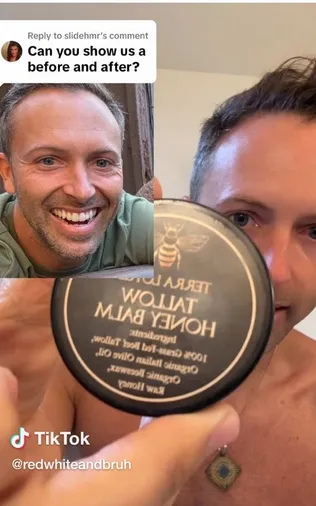
Our cover is a reply video by @redwhiteandbruh, captioned “I wish I knew about all the benefits beef Tallow has for our skin 20 years ago”. The clip sits at 12.2 million views and 67,179 likes. The jar he holds up lists grass-fed tallow, olive oil, beeswax and raw honey. Keep that olive oil in mind.
The pitch: animal fat resembles our own skin fat, so tallow must be the perfect moisturizer. Sounds logical. Nobody checked.
You want clear, glassy skin → you swap your moisturizer for rendered beef fat → the rich film feels great, but its oleic acid can loosen the barrier and, in animal tests, plug pores → what moves it is a plain fragrance-free moisturizer, Vaseline for flaky spots and actual acne treatment.
We looked for the tallow trials
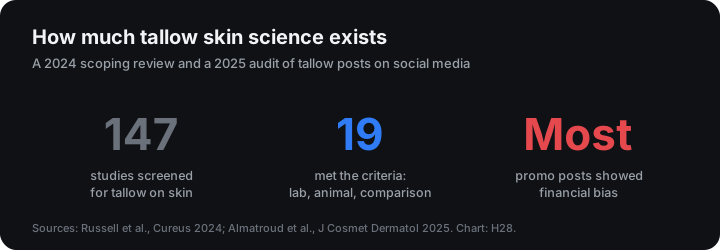
A 2024 scoping review searched PubMed and EMBASE for tallow on skin (Russell et al., 2024). It screened 147 papers and kept 19: comparison studies, lab work and animal work. Human cosmetic research, the authors wrote, is still missing, and side effects were where sources disagreed most.
Our own PubMed searches for tallow, animal fat and cosmetics turned up soap bars, frying oil and cattle feed. Not one randomized trial on human faces.
The 2025 social media audit read posts on YouTube, Instagram and TikTok (Almatroud et al., 2025). Most promoters had no healthcare credentials, most showed financial bias, and the “evidence” usually meant studies on tallow’s ingredients, not tallow.
What’s actually in the jar
Tallow is not one fixed thing. Four beef tallows analysed in 2026 ranged from about 42% to 66% saturated fat (Sun et al., 2026). The softest one, the kind that melts nicely on warm skin, held the most oleic acid.
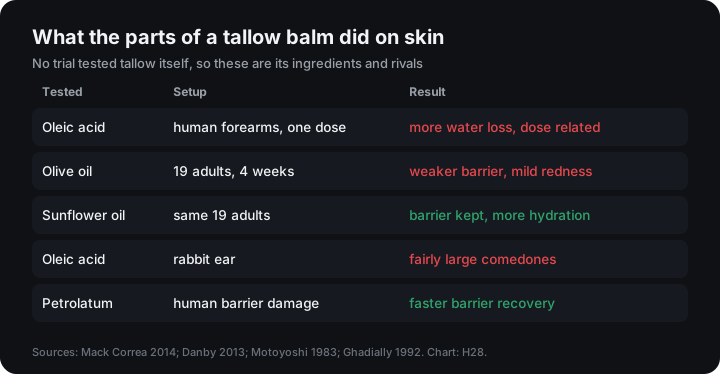
That matters because oleic acid is the best studied part. Applied once to human forearms, it raised water loss through the skin in a dose-dependent way and slipped between the lipid layers that hold the barrier together (Mack Correa et al., 2014). In 19 adults, olive oil, which is rich in oleic acid, weakened the outer skin layer within four weeks and caused mild redness, while sunflower oil on the other arm kept the barrier intact and improved hydration (Danby et al., 2013). “Natural” oils don’t behave alike.
On rabbit ears, the old screening test for pore clogging, oleic acid produced fairly large comedones, and so did its oxidized form (Motoyoshi, 1983). Rabbits aren’t people, but it’s the only comedone data we found for oleic acid.
The boring rival with receipts
Petrolatum is the occlusive tallow fans love to dunk on. In volunteers with a stripped barrier, it sped up recovery instead of smothering the skin, spreading through the gaps between skin cells (Ghadially et al., 1992). A cream packed with “skin-identical” lipids did no better than pure petrolatum at repairing damaged human skin (Lodén and Bárány, 2000).
Heavy creams and breakouts
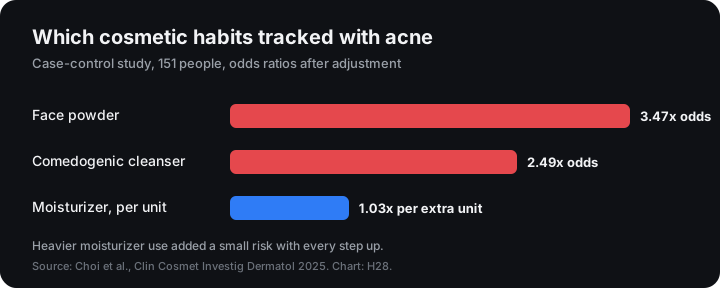
Does piling on rich products track with pimples? In a case-control study of 151 people, face powder and cleansers with comedogenic ingredients were tied to more acne, and every step up in moisturizer use nudged risk higher (Choi et al., 2025). Tallow wasn’t tested. Extra grease still isn’t free.
If tallow is already on your shelf
Dry, not breaking out, and you like the tallow? It’s probably fine as a night balm. Acne-prone? Skip it, and skip olive oil blends too. Want barrier repair? The petroleum jelly from the rival section. Want fewer spots and lines? Sunscreen has the trials tallow lacks; see Tanmaxxing Bronzes the Face It Ages.
FAQ
Does beef tallow clog pores? Nobody has tested tallow itself for comedones in people. Its oleic acid formed comedones in rabbit ear tests, so acne-prone skin should count that as a warning.
Is tallow better than regular moisturizer? No study compares them. Petrolatum, the cheapest occlusive around, has human data showing faster barrier repair, which tallow does not.
Can tallow help eczema? Claims online say so, but no trial backs them. Oleic acid rich oils damaged the barrier in people with and without eczema history, so ask a dermatologist first.
References
- Russell MF, Sandhu M, Vail M, Haran C, Batool U, Leo J. Tallow, rendered animal fat, and its biocompatibility with skin: a scoping review. Cureus. 2024;16(5):e60981. PMID: 38910727. doi:10.7759/cureus.60981
- Almatroud L, Choi S, Libson K, Ashack K. Beef tallow-based skincare claims in social media: a cross-sectional analysis. J Cosmet Dermatol. 2025;24(12):e70544. PMID: 41312576. doi:10.1111/jocd.70544
- Sun L, Li J, Zhu C, Xu L, Li M, Zhao G. Comparative analysis of physicochemical properties, crystallization behaviors, polymorphic forms and microstructure of beef tallow from different breeds. J Sci Food Agric. 2026;106(11):6337-6347. PMID: 42135930. doi:10.1002/jsfa.70667
- Mack Correa MC, Mao G, Saad P, Flach CR, Mendelsohn R, Walters RM. Molecular interactions of plant oil components with stratum corneum lipids correlate with clinical measures of skin barrier function. Exp Dermatol. 2014;23(1):39-44. PMID: 24372651. doi:10.1111/exd.12296
- Danby SG, AlEnezi T, Sultan A, Lavender T, Chittock J, Brown K, Cork MJ. Effect of olive and sunflower seed oil on the adult skin barrier: implications for neonatal skin care. Pediatr Dermatol. 2013;30(1):42-50. PMID: 22995032. doi:10.1111/j.1525-1470.2012.01865.x
- Motoyoshi K. Enhanced comedo formation in rabbit ear skin by squalene and oleic acid peroxides. Br J Dermatol. 1983;109(2):191-8. PMID: 6223652. doi:10.1111/j.1365-2133.1983.tb07080.x
- Ghadially R, Halkier-Sorensen L, Elias PM. Effects of petrolatum on stratum corneum structure and function. J Am Acad Dermatol. 1992;26(3 Pt 2):387-96. PMID: 1564142. doi:10.1016/0190-9622(92)70060-s
- Lodén M, Bárány E. Skin-identical lipids versus petrolatum in the treatment of tape-stripped and detergent-perturbed human skin. Acta Derm Venereol. 2000;80(6):412-5. PMID: 11243632. doi:10.1080/000155500300012774
- Choi K, Liu H, Zhu Y, Jiang Z, Lu S. A case-control study exploring the association between cosmetic use and acne risk: implications for prevention and clinical practice. Clin Cosmet Investig Dermatol. 2025;18:1833-1843. PMID: 40765696. doi:10.2147/CCID.S533950
Cover: screenshot of a TikTok video, shared as commentary.