· H28 · Myths · 5 min read
A Bad Week of Sleep Shows on Your Face
Sleepmaxxing sold the basket. The hours did the work.

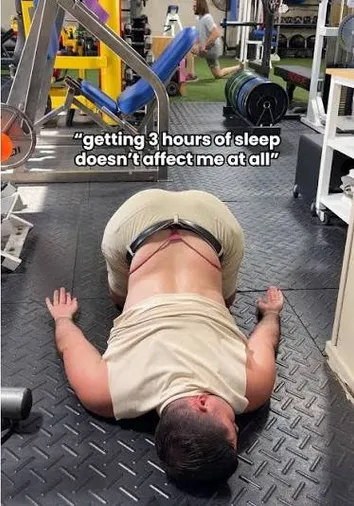
Yes, sleep changes how attractive you look, but a single bad night usually doesn’t show. In the biggest study, people who skipped a night looked the same as rested ones, on camera and to raters. A few short nights in a row do show: strangers rate you as less attractive, and months of poor sleep reach your skin.
Verdict: Partly works.
You know the morning: four hours of sleep, an important day ahead, and a bathroom light that makes your eyelids look heavy. Here’s how much of that other people can see.
The sleepmaxxing pitch
Sleepmaxxing is TikTok’s name for bedtime baskets, sleep sprays, mouth tape and night routines. One video titled “Sleep changes your face” has 5.5 million plays. The promise: sleep more and you’ll look better, with clearer skin and no dark circles.
You want to look fresher → you buy the basket, the spray and the mouth tape → the products aren’t what moves your face → the hours you sleep, night after night, are.
What a sleepless face looks like
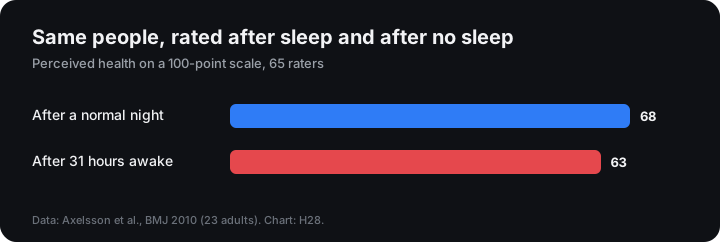
Researchers at the Karolinska sleep lab in Stockholm photographed 23 healthy adults, aged 18 to 31, after a normal 8-hour night and again after 31 hours awake. Then 65 strangers rated the photos in random order (Axelsson et al., 2010).
The tired faces scored 63 for health against 68 when rested, and came across as less appealing and more worn out. The researchers titled their paper “Beauty sleep”, and they meant it.
A follow-up with the same design pinned down what people were noticing: hanging eyelids, redder and more swollen eyes, darker circles, paler skin, more fine lines and droopier mouth corners. The faces also looked sadder (Sundelin et al., 2013).
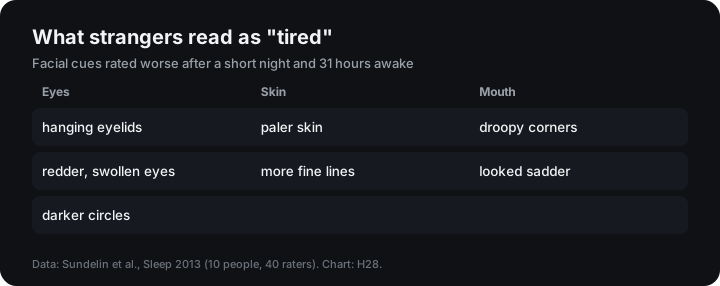
Most of that list lives around the eyes, which is where people look first when they read a face. It’s why a tired person often looks “off” before anyone can say why.
The twist: one night is hard to spot
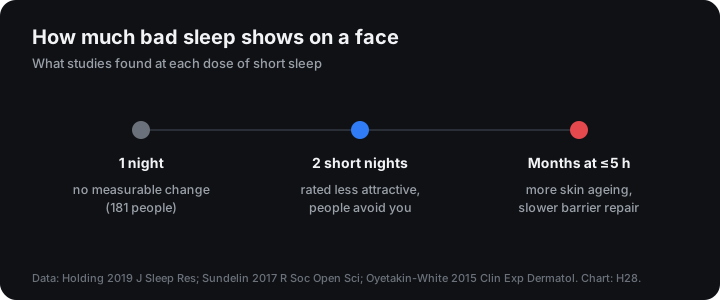
That big study randomized 181 people to either a normal night or no sleep at all (Holding et al., 2019). It measured skin colour with a spectrophotometer and analysed eye openness, mouth shape and under-eye darkness in the photos.
The two groups came out the same, and raters couldn’t tell them apart. What did predict looking tired, across everyone, was the same short list: paler skin, less open eyes, a downturned mouth and darker under-eyes. The cues are real. One rough night often isn’t enough to switch them on.
Two short nights change the room
When 25 people were photographed after two nights of restricted sleep, 122 raters found them less good-looking, less well and sleepier, and said they’d rather not socialize with them. Oddly, they didn’t seem any less trustworthy (Sundelin et al., 2017).
Over months, it reaches the skin. A dermatology study compared 60 women: those sleeping 5 hours or less against those getting 7 to 9. The longer sleepers showed fewer signs of skin ageing, repaired a damaged skin barrier 30% better within 72 hours, recovered faster from UV redness, and liked their own looks more (Oyetakin-White et al., 2015).
Puffy lids after a rough night are fluid and fade by lunch. Round cheeks are a separate issue, fat, which we covered in face yoga made their cheeks fuller.
What to do tonight, and next week
- Protect the week, not the night. One rough evening before an interview is survivable. Five of them back to back show.
- Aim for 7 to 9 hours. That’s the range the healthier-skinned group slept.
- Keep the ritual if it helps you fall asleep. None of these studies tested sprays, tape or baskets. The effects came from time asleep.
- Judge your face on a normal week. A photo taken on no sleep is not your baseline.
FAQ
Does one all-nighter change how you look? Usually not enough for anyone to notice. It’s the run of short nights that shows.
Does sleep get rid of dark circles? Short sleep makes under-eye circles look darker, so steady sleep helps them look lighter. It won’t remove circles that come from genetics or skin thickness.
Do sleep sprays or mouth tape improve your face? No study here tested them. If they help you sleep longer, the sleep is what helps your face.
References
- Axelsson J, Sundelin T, Ingre M, Van Someren EJ, Olsson A, Lekander M. Beauty sleep: experimental study on the perceived health and attractiveness of sleep deprived people. BMJ. 2010;341:c6614. PMID: 21156746. doi:10.1136/bmj.c6614
- Sundelin T, Lekander M, Kecklund G, Van Someren EJ, Olsson A, Axelsson J. Cues of fatigue: effects of sleep deprivation on facial appearance. Sleep. 2013;36(9):1355-60. PMID: 23997369. doi:10.5665/sleep.2964
- Sundelin T, Lekander M, Sorjonen K, Axelsson J. Negative effects of restricted sleep on facial appearance and social appeal. R Soc Open Sci. 2017;4(5):160918. PMID: 28572989. doi:10.1098/rsos.160918
- Holding BC, Sundelin T, Cairns P, Perrett DI, Axelsson J. The effect of sleep deprivation on objective and subjective measures of facial appearance. J Sleep Res. 2019;28(6):e12860. PMID: 31006920. doi:10.1111/jsr.12860
- Oyetakin-White P, Suggs A, Koo B, et al. Does poor sleep quality affect skin ageing? Clin Exp Dermatol. 2015;40(1):17-22. PMID: 25266053. doi:10.1111/ced.12455
Cover: screenshot of a TikTok video, shared as commentary.