· H28 · Myths · 5 min read
Your Collagen Powder Has a Funding Problem
The trials that praise the scoop mostly share one thing: the company paying for them.


Collagen supplements have not been shown to improve skin once you set aside the trials paid for by the companies selling them. A 2025 meta-analysis of 23 randomized trials found better hydration, elasticity and wrinkles with every study pooled, and nothing at all in the independently funded ones. The high-quality trials also came up empty.
Verdict: Doesn’t.
Why everyone is scooping
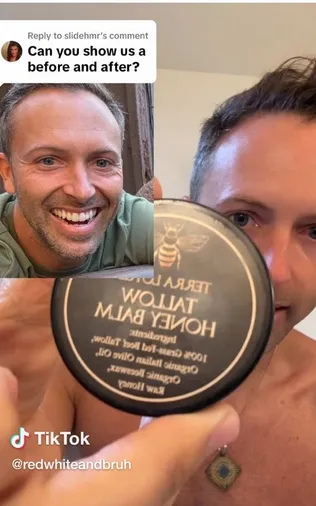
@aamnaadel, a creator filming in scrubs, captioned one clip “Taking collagen supplements to get ‘good skin’”. It has 4.9 million plays and 144 thousand likes. The glass-skin crowd treats the powder as a basic step: stir it into coffee, wait a few months, watch the lines soften.
The logic sounds airtight. Skin is built largely from collagen, collagen drops with age, so eat collagen. Your body didn’t read that pitch.
You want firm, glassy skin → you drink a collagen scoop every morning → it lands in your blood as tiny fragments and the independent trials see no change in your face → what moves it is sunscreen and a retinoid.
What happens to the scoop
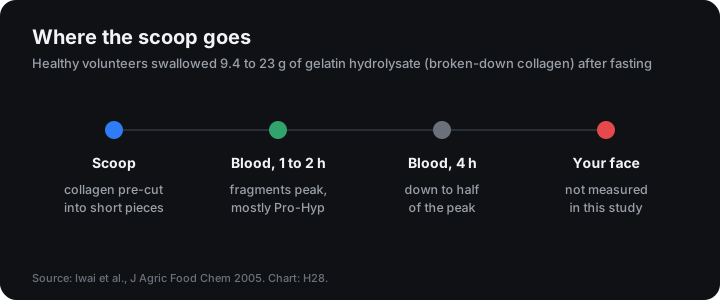
Collagen powder is sold as “hydrolyzed”, meaning the long protein has already been cut into shorter pieces. What reaches your blood is smaller still. In one study, healthy volunteers swallowed 9.4 to 23 grams of gelatin hydrolysate after a 12-hour fast (Iwai et al., 2005). Collagen fragments in their blood peaked 1 to 2 hours later, mostly a two-unit piece called Pro-Hyp, and had fallen to half that level by hour four.
So something from the scoop does reach your blood. That study never checked whether any of it reached the skin or rebuilt anything there.
The trials that say yes
On paper the case looks strong. A 2021 meta-analysis pooled 19 studies with 1,125 people aged 20 to 70, and 95% of them were women; it concluded 90 days of hydrolyzed collagen reduced wrinkles and improved hydration and elasticity (de Miranda et al., 2021). A 2023 review of 26 trials with 1,721 patients also found gains in hydration and elasticity, but flagged several biases in the included studies (Pu et al., 2023).
Then someone split them by funding
In 2025, two researchers pooled 23 randomized trials with 1,474 people and then did what the earlier reviews hadn’t: they sorted the trials by who paid (Myung and Park, 2025).
The trials funded by supplement companies showed improvements on all three measures. The trials without that money showed no effect on any of the three. Sorting by quality told the same story: high-quality studies found nothing in every category, while the weaker ones found better elasticity. Their conclusion was blunt: no clinical evidence supports collagen supplements to prevent or treat skin aging.
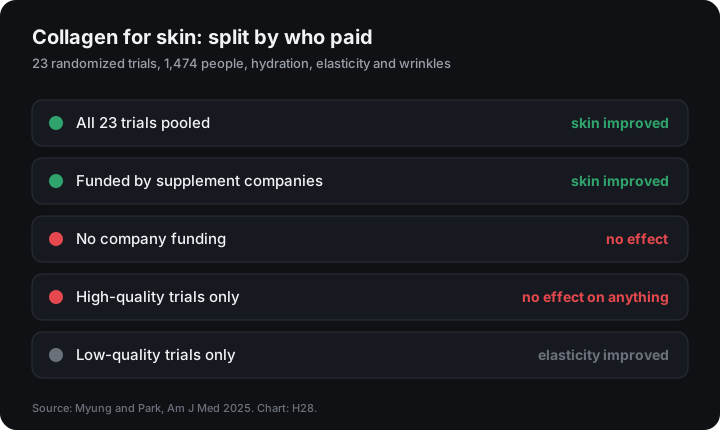
When an effect lives only where the seller holds the checkbook, that’s usually not biology.
What does build collagen in skin
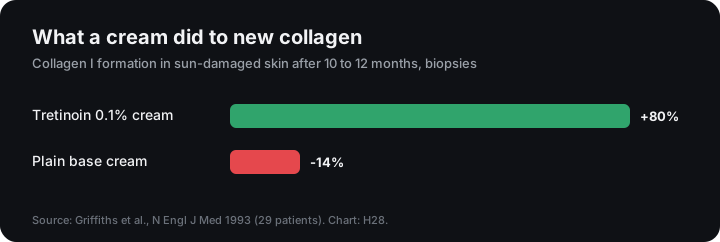
Sun is the big collagen thief. Biopsies from sun-damaged forearms showed 56% less new collagen I than skin from the buttocks, which rarely sees daylight (Griffiths et al., 1993). In the same study, 29 patients used either 0.1% tretinoin or a plain cream for 10 to 12 months. New collagen rose 80% with tretinoin and fell 14% with the base cream.
Tretinoin is a prescription retinoid, so it’s a conversation with a dermatologist, not a TikTok haul. The other half is daily sunscreen, which slowed visible aging in a long Australian trial covered in Tanmaxxing Bronzes the Face It Ages.
The swap we’d make
If you like the powder in your coffee, keep it; the FAQ covers safety. Just don’t pay a beauty markup for it. Spend that money on a sunscreen you’ll actually wear every morning and ask a dermatologist whether a retinoid fits your skin. Then shoot a selfie by the same window every couple of months and let that settle it.
FAQ
Does marine collagen work better than bovine? No source beats another in the evidence we read. A 2023 review found no significant difference between collagen sources for elasticity, and trials without industry money showed no benefit from any source.
How long do collagen supplements take to work? The upbeat 2021 review pointed to about 90 days of use. That timeline comes from pooled trials, though, and the unfunded ones found nothing to wait for.
Is collagen powder bad for you? Probably not. A 2019 systematic review of oral collagen in dermatology called it generally safe, with no reported adverse events (Choi et al., 2019), so the real cost is your money, not your health.
References
- Myung SK, Park Y. Effects of Collagen Supplements on Skin Aging: A Systematic Review and Meta-Analysis of Randomized Controlled Trials. Am J Med. 2025;138(9):1264-1277. PMID: 40324552. doi:10.1016/j.amjmed.2025.04.034
- Iwai K, Hasegawa T, Taguchi Y, et al. Identification of food-derived collagen peptides in human blood after oral ingestion of gelatin hydrolysates. J Agric Food Chem. 2005;53(16):6531-6. PMID: 16076145. doi:10.1021/jf050206p
- de Miranda RB, Weimer P, Rossi RC. Effects of hydrolyzed collagen supplementation on skin aging: a systematic review and meta-analysis. Int J Dermatol. 2021;60(12):1449-1461. PMID: 33742704. doi:10.1111/ijd.15518
- Pu SY, Huang YL, Pu CM, et al. Effects of Oral Collagen for Skin Anti-Aging: A Systematic Review and Meta-Analysis. Nutrients. 2023;15(9):2080. PMID: 37432180. doi:10.3390/nu15092080
- Griffiths CE, Russman AN, Majmudar G, Singer RS, Hamilton TA, Voorhees JJ. Restoration of collagen formation in photodamaged human skin by tretinoin (retinoic acid). N Engl J Med. 1993;329(8):530-5. PMID: 8336752. doi:10.1056/NEJM199308193290803
- Choi FD, Sung CT, Juhasz ML, Mesinkovsk NA. Oral Collagen Supplementation: A Systematic Review of Dermatological Applications. J Drugs Dermatol. 2019;18(1):9-16. PMID: 30681787.
Cover: screenshot of a TikTok video, shared as commentary.