· H28 · Myths · 5 min read
Tanmaxxing Bronzes the Face It Ages
Crisp tan lines this summer, a few extra years on your face by the next.


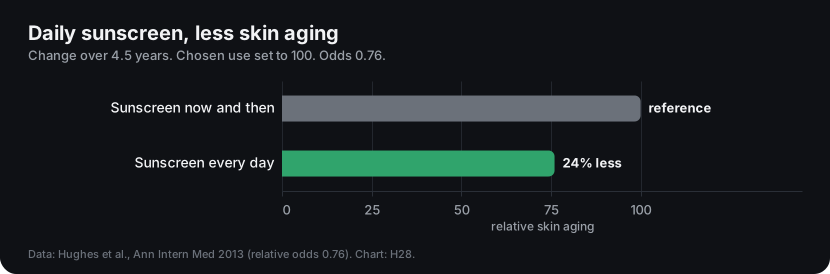
Tanmaxxing ages your face. In a study of 298 women, sun exposure accounted for an estimated 80% of the visible signs of facial ageing, mostly uneven pigment and wrinkles. A randomized trial found the opposite habit, daily sunscreen, cut skin ageing by a quarter.
Verdict: Dangerous. The tan fades. The damage it’s paid for doesn’t.
Tanmaxxing is the 2026 trend of chasing a deep tan on purpose, often by lying out when the UV index is highest, oiled up and unprotected. Dermatologists spent the summer warning about it. Here’s what the research says you trade for the colour.
Why a tan looks good in the first place
The trend isn’t built on nothing. When researchers edited the skin colour of faces in photos, raters found both a deeper, melanin tan and a golden, carotenoid glow more attractive than paler versions (Lefevre and Perrett, 2015). A tan helped male faces more than female ones.
But when the depth of colour was matched, the carotenoid glow, which comes from a diet heavy in produce, beat the tan every time. The colour people like is available without the sun.
You want a warmer, healthier-looking face → you lie out at peak UV with oil and no sunscreen → you get the colour, plus spots, lines and rougher skin that build up every season → a daily sunscreen and a plate of vegetables give you the glow without the ageing.
What the sun does to a face
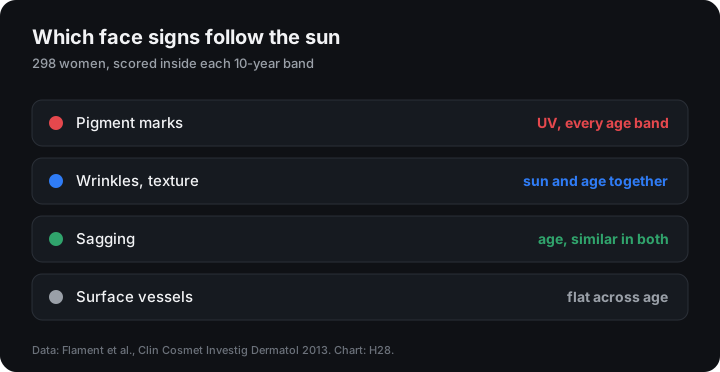
A dermatology team studied 298 women aged 30 to 78, split into 157 sun-seekers and 141 sun-avoiders based on a dermatologist’s reading of their skin. Trained raters scored 22 signs of ageing on each face (Flament et al., 2013).
Blotchy pigment and dark spots were more common in the sun-seekers in every age group. Wrinkles and rough texture tracked both sun exposure and age. Sagging followed age alone and looked the same in both groups. Overall, the authors put roughly 80% of what makes a face look older down to UV.
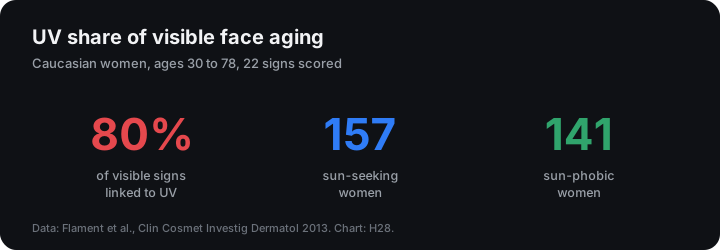
The study only included women, and the groups were built from signs of sun damage, so the 80% is an estimate rather than a fixed law. Men’s skin follows the same biology, and men wear sunscreen far less, so there’s no reason to expect a better deal. The pattern is still clear: the sun writes most of what ageing looks like on a face.
What daily sunscreen does
The best evidence comes from Nambour, a sunny town in Queensland, Australia. Researchers randomly assigned 903 adults under 55 to use broad-spectrum sunscreen daily or at their own discretion (Hughes et al., 2013). Over 4.5 years, the daily group’s skin showed no measurable ageing at all. Compared with occasional users, their skin aged 24% less. A beta-carotene supplement tested alongside it did nothing.
The same trial kept following 1,621 residents for ten years after it ended. The daily sunscreen group had 11 new melanomas against 22 in the occasional group, and 3 invasive melanomas against 11 (Green et al., 2011). The overall melanoma result sat right at the edge of statistical significance; the drop in invasive melanoma was clearer.
How to keep the glow and your skin
- Wear sunscreen every morning, not only on beach days. That habit is what stopped skin ageing in the trial.
- Skip peak UV sessions. Ordinary daylight is fine; lying out at the highest index is the part that costs you.
- Eat your colour. Fruit and vegetables give a golden tone that raters liked even more than a tan.
- Want it darker? Self-tanner colours the skin without UV.
Sleep leaves its own marks on skin, which we covered in a bad week of sleep shows on your face.
FAQ
Does tanning age your face? Yes. UV is the main driver of dark spots, blotchy tone and wrinkles, and repeated tanning adds to that damage every season.
Does daily sunscreen prevent skin ageing? It slows it a lot. In the best trial, people who applied it every morning aged about a quarter less than people who used it now and then.
Is a tan more attractive? In photo studies a tan did make faces more attractive, especially men’s, but a golden glow from carotenoid-rich food was preferred when the colour depth matched.
References
- Lefevre CE, Perrett DI. Fruit over sunbed: carotenoid skin colouration is found more attractive than melanin colouration. Q J Exp Psychol (Hove). 2015;68(2):284-93. PMID: 25014019. doi:10.1080/17470218.2014.944194
- Flament F, Bazin R, Laquieze S, Rubert V, Simonpietri E, Piot B. Effect of the sun on visible clinical signs of aging in Caucasian skin. Clin Cosmet Investig Dermatol. 2013;6:221-32. PMID: 24101874. doi:10.2147/CCID.S44686
- Hughes MCB, Williams GM, Baker P, Green AC. Sunscreen and prevention of skin aging: a randomized trial. Ann Intern Med. 2013;158(11):781-90. PMID: 23732711. doi:10.7326/0003-4819-158-11-201306040-00002
- Green AC, Williams GM, Logan V, Strutton GM. Reduced melanoma after regular sunscreen use: randomized trial follow-up. J Clin Oncol. 2011;29(3):257-63. PMID: 21135266. doi:10.1200/JCO.2010.28.7078
Cover: screenshot of a TikTok video, shared as commentary.