· H28 · Myths · 6 min read
Mewing After 18 Is a Pose, Not a Jawline
Why an adult palate ignores your tongue, and why the before-and-afters still look real.

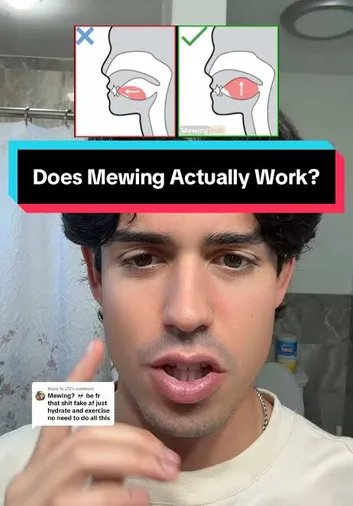
You’ve done it. You caught yourself sideways in a car window, watched your jaw melt into your neck, and flattened your tongue hard against your palate before anyone noticed.
That’s mewing, and if you’re waiting for it to change your face: it won’t. No study shows mewing reshapes an adult jaw or face. Your tongue can nudge teeth; adult facial bone takes screws or a surgeon.
Verdict: Doesn’t work for adults.
The promise
Your tongue is “your natural retainer that expands the palate and grows your face upwards and forwards,” reads one post with 166,000 views.
It started as British orthodontist John Mew’s “orthotropics”, made famous on YouTube by his son Mike Mew, and now comes with thumb pulling and paid courses. The usual loop:
You want a sharper jaw → you mewed for months → the area under your chin tightened while you held it, and maybe your teeth shifted a little → your bones stayed exactly where they were.
The true part: your tongue moves teeth
Teeth settle wherever the forces around them cancel out, and the biggest of those are the resting pressure of your tongue from the inside and your lips and cheeks from the outside (Proffit, 1978).
So tongue posture shapes where your teeth sit, which is why pushing hard for hours has downsides (see the FAQ). Moving teeth doesn’t move the jaw they’re planted in.
The problem: your palate has zipped shut
To widen or push forward your upper jaw, the seam down the middle of your palate (the midpalatal suture) has to open. In a kid it’s loose. Through your teens it interlocks and fuses.
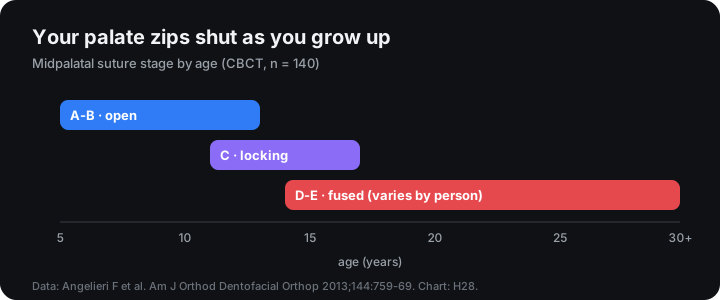
A CT study of 140 people found the suture typically open until about 13, and almost a quarter of boys aged 14 to 17 already partly fused (Angelieri et al., 2013).
So when an adult needs a wider upper jaw, orthodontists don’t prescribe tongue posture. They anchor mini-screws in the roof of the mouth and crank an expander against bone (MARPE, about 94% success in a 2023 review, Zeng et al.). When that isn’t enough, it’s surgery.
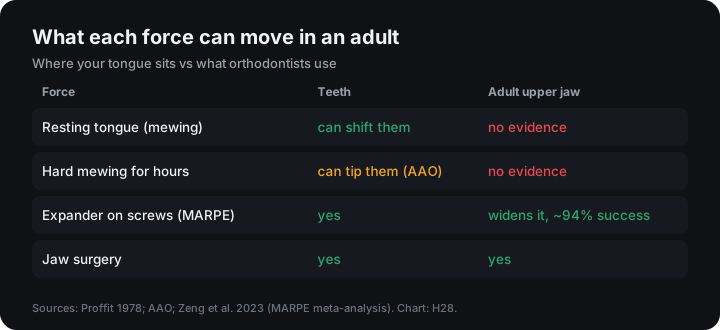
Your resting tongue is a feather. That expander is a car jack bolted to your skull, and adult bone only listens to the jack.
Then why do the transformation photos look so real?
None of these is bone growth:
- It’s a pose. Tensing the tongue tightens the muscles below your jaw, like sucking in a stomach. Relax and it’s gone.
- Puberty. One X user nailed it: photograph yourself at 14, again after puberty, and post it as “jawline gains from my special mewing variation. DM for paid course.”
- Fat loss. People start mewing and the gym the same month; the tongue gets the credit.
- The camera. Angle, head tilt and lens distance change a profile more than a year of mewing.
A Reddit user who mewed from 21 to 26 says his face got wider from chewing, “but when it came to bone structure, there was absolutely no change.”
What science has checked
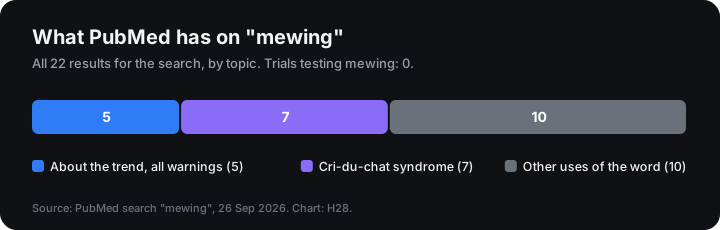
We searched PubMed for “mewing.” It returns 22 papers, and seven are about cri-du-chat, a genetic syndrome named for a baby’s cat-like cry. Five are about the trend, all warnings: from surgeons (Lee et al., 2019), pediatricians (Mekhail et al., 2026), and researchers tracking looksmaxxing’s “pseudoscientific language” (Grillo et al., 2026). Not one is a trial.
Closest thing: in 2026, 14 young adults did five weeks of tongue training and their posture improved (Van der Straeten et al., 2026). Nobody measured their faces.
And in 2024, the UK’s General Dental Council struck Mike Mew off its register for “approaches not sufficiently supported by scientific evidence” that were “liable to cause harm.”
What we’d tell a friend
- Drop some body fat. Your jaw may already be there, under a layer you can lose.
- Fix your head posture. A forward head blurs your jawline in photos.
- Keep your lips closed and breathe through your nose. Good habit, zero cost, no bone moved.
- See an orthodontist if your bite or breathing is off.
- Stop checking the mirror. It adapts to you. Same-light photos every few weeks don’t.
FAQ
What about teenagers? Different story, because their faces are still growing. We wrote it up separately: does mewing work for teenagers?
Is mewing bad for you? Normal resting posture is harmless. The American Association of Orthodontists (AAO) warns that heavy pressure for hours (“hard mewing”) can shift teeth, open your bite and strain your jaw joint.
How long until it works? On adult bone, there’s no evidence it ever does. Anything you see in weeks is one of the four things above.
References
- Proffit WR. Equilibrium theory revisited: factors influencing position of the teeth. Angle Orthod. 1978;48(3):175-86. PMID: 280125. doi:10.1043/0003-3219(1978)048<0175:ETRFIP>2.0.CO;2
- Angelieri F, Cevidanes LH, Franchi L, et al. Midpalatal suture maturation: classification method for individual assessment before rapid maxillary expansion. Am J Orthod Dentofacial Orthop. 2013;144(5):759-69. PMID: 24182592. doi:10.1016/j.ajodo.2013.04.022
- Zeng W, Yan S, Yi Y, et al. Long-term efficacy and stability of miniscrew-assisted rapid palatal expansion in mid to late adolescents and adults: a systematic review and meta-analysis. BMC Oral Health. 2023;23(1):829. PMID: 37924088. doi:10.1186/s12903-023-03574-y
- Van der Straeten C, Verbeke J, Bettens K, et al. OMA-Project: effectiveness of orofacial myofunctional therapy protocols in healthy young adults. J Oral Rehabil. 2026;53(5):945-59. PMID: 41542964. doi:10.1111/joor.70150
- Lee UK, Graves LL, Friedlander AH. Mewing: social media’s alternative to orthognathic surgery? J Oral Maxillofac Surg. 2019;77(9):1743-4. PMID: 31005620. doi:10.1016/j.joms.2019.03.024
- Mekhail J, Howard C, Milanaik R. From mewing to peptides: looksmaxxing as an emerging pediatric concern. Pediatrics. 2026;158(3):e2026077705. PMID: 42580741. doi:10.1542/peds.2026-077705
- Grillo R, Fernandes LA, Rodrigues Dos Santos LA, et al. Dangerous trends on social media related to facial esthetics: analysis of looksmaxxing, softmaxxing and hardmaxxing practices. J Stomatol Oral Maxillofac Surg. 2026;127(5):102971. PMID: 42674114. doi:10.1016/j.jormas.2026.102971
- American Association of Orthodontists. Does mewing actually reshape your jaw? aaoinfo.org, 2025 (updated 2026).
- General Dental Council fitness-to-practise decision, Michael Gordon Mew, 2024 (reported by DentistryIQ, 20 Dec 2024).
Cover: screenshot of a TikTok video, shared as commentary.