· H28 · Myths · 5 min read
Braces Didn't Push Your Jaw Back
What changes after tooth extractions is a couple of millimetres of lip, not your skull.


No, braces with tooth extractions don’t push your upper jaw back. When trials compared people who had premolars removed with people who didn’t, the position of the upper jaw bone came out the same. What can change is the lips: after extractions they tend to rest a millimetre or two deeper, which can make your profile look a little flatter.
Verdict: Doesn’t recess your maxilla. Your lip position can shift slightly.
The braces came off, you took a side-profile photo, and someone in the comments said your midface is “recessed” and your orthodontist ruined it. That comment mixes up two different things: where your lips sit and where your jaw bone sits.
You want a strong midface → you had braces, maybe with a few teeth removed → your lips settled slightly and the profile photo looks flatter → the jaw bone stayed where it was, so what you’re seeing is soft tissue.
Did the upper jaw move back?
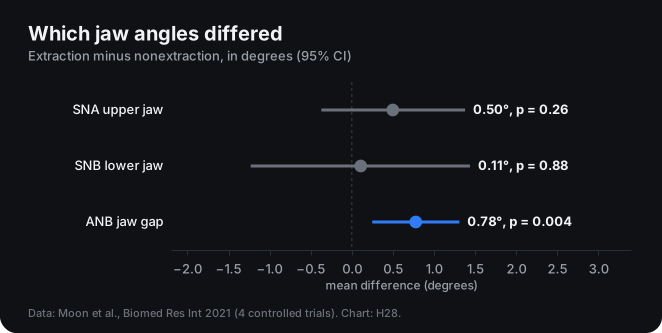
Orthodontists measure upper jaw position on a side X-ray with an angle called SNA. If extractions dragged the jaw backward, SNA would shrink.
A 2021 review pooled four controlled trials and found no real difference in SNA between people treated with and without extractions: half a degree, well within the noise (Moon et al., 2021). The lower jaw didn’t differ either. The only measurable change was a small shift in how the two jaws relate to each other.
A study of adults who needed extractions pointed the same way: teeth and soft tissue changed, the skeleton didn’t (Maaz and Fida, 2022).
What does change: the lips
The biggest review looked at dozens of studies and more than a thousand patients (Konstantonis et al., 2018). With extractions, the lower lip ended up roughly 2 mm deeper than without, and the upper lip about 1.3 mm. The angle under the nose opened slightly.
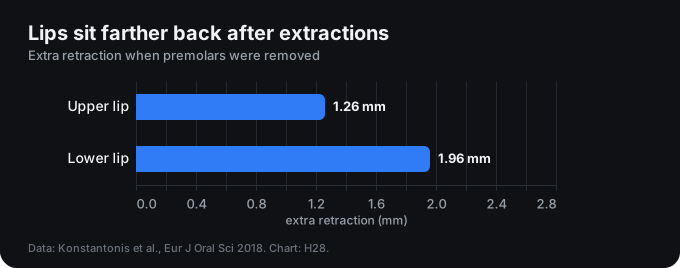
How much the lips moved depended on age, which teeth were removed and the distance the incisors were retracted. The authors rated the evidence as very low quality and said it can’t predict what happens to any one person. In the few studies that asked people to rate profiles, extraction faces were rated slightly more pleasant, not less.
Does the arch get narrower?
A little, at the back. A 2024 review of 30 studies found that after removing four premolars, the distance between the back molars was about 2 mm narrower in both jaws (Elias et al., 2024). The width at the canines, which frame your smile, didn’t differ, and neither did how attractive the finished smiles looked.

A matched study of 68 patients showed a similar picture: the extraction group’s teeth and profile moved back slightly, mostly at the lips, and the two groups ended up statistically similar (Kouli et al., 2019).
Why the “ruined face” story spreads
None of this means your worry is silly. A face you’ve looked at for years suddenly looks different, and the internet hands you a scary label for it.
Extractions are usually done when teeth are crowded or sticking out. Moving the incisors back fixes that, and the lips follow them. On a profile photo a slightly flatter lip line is easy to spot and easy to blame on bone, especially when you’re comparing against a face you remember from years earlier. For teenagers there’s also growth: faces keep changing for years after braces, which we covered in mewing at 15.
What we’d tell a friend
If your lips feel flatter than you’d like, ask your orthodontist to compare your before and after X-rays and tell you how far your front teeth moved. That’s what drives the lip change. A comment under a video is judging one selfie.
FAQ
Can braces cause a recessed maxilla? The evidence says no. Pooled trials found the maxilla sitting in the same place whether or not premolars had been taken out.
Do tooth extractions flatten your face? They can let the lips settle a little deeper on average, which may soften a profile slightly. Facial bones stay put.
What should I ask my orthodontist? Ask for your start and finish X-rays side by side and how many millimetres your upper incisors travelled. That number explains most of any lip change.
References
- Konstantonis D, Vasileiou D, Papageorgiou SN, Eliades T. Soft tissue changes following extraction vs. nonextraction orthodontic fixed appliance treatment: a systematic review and meta-analysis. Eur J Oral Sci. 2018;126(3):167-179. PMID: 29480521. doi:10.1111/eos.12409
- Moon S, Mohamed AMA, He Y, Dong W, Yaosen C, Yang Y. Extraction vs. nonextraction on soft-tissue profile change in patients with malocclusion: a systematic review and meta-analysis. Biomed Res Int. 2021;2021:7751516. PMID: 34589550. doi:10.1155/2021/7751516
- Elias KG, Sivamurthy G, Bearn DR. Extraction vs nonextraction orthodontic treatment: a systematic review and meta-analysis. Angle Orthod. 2024;94(1):83-106. PMID: 37899069. doi:10.2319/021123-98.1
- Kouli A, Papagiannis A, Konstantoni N, Halazonetis DJ, Konstantonis D. A geometric morphometric evaluation of hard and soft tissue profile changes in borderline extraction versus non-extraction patients. Eur J Orthod. 2019;41(3):264-272. PMID: 30212892. doi:10.1093/ejo/cjy056
- Maaz M, Fida M. Dental, skeletal, and soft-tissue changes in adult orthodontic patients treated with premolar extraction and nonextraction: a cross-sectional study. Am J Orthod Dentofacial Orthop. 2022;162(3):360-366. PMID: 35570094. doi:10.1016/j.ajodo.2021.04.026
Cover: screenshot of a TikTok video, shared as commentary.