· H28 · Protocols · 7 min read
Tretinoin Is Worth the First Month of Peeling
Nearly forty years of trials back the tube. None of them promised your first weeks would be pretty.

Tretinoin is one of the few skin creams with decades of randomized trials showing it really changes a face. It softens fine wrinkles, evens out blotchy pigment and cuts acne lesions roughly in half over three months. The price is time and irritation: red, peeling skin is common early, and the anti-aging payoff builds over months to years.
Verdict: Works, with caveats.
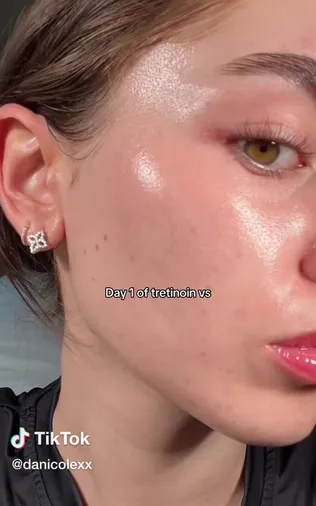
@danicolexx captioned a close-up of her cheek “The tretinoin purge better be worth it”. That clip has passed 6.2 million plays, with 168 thousand people tapping the heart. The trials say it usually is worth it, just on a slower clock than your camera roll.
You want smoother, clearer skin → you start tretinoin and pile on every acid in your cabinet → your face turns red and flaky for weeks, so you quit and call it a failed purge → the fix is a gentle start set by a dermatologist, fewer other actives and six months of patience.
What it does to wrinkles
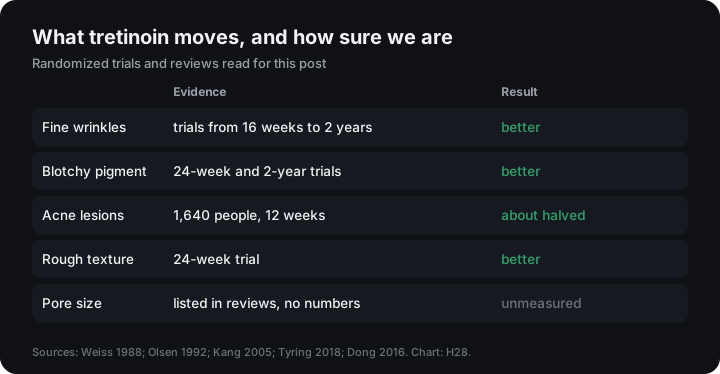
Tretinoin is retinoic acid, prescription vitamin A. The first proper test came in 1988: 30 people with sun-damaged skin used it for 16 weeks (Weiss et al., 1988). Fourteen of the 15 who put it on their faces improved. Not one face on the plain cream did.
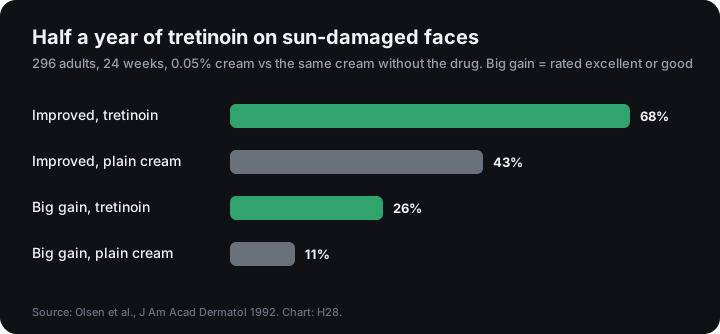
In 296 adults over 24 weeks, 68% improved on the 0.05% cream against 43% on the base cream, and fine wrinkles, mottled pigment and roughness all responded (Olsen et al., 1992).
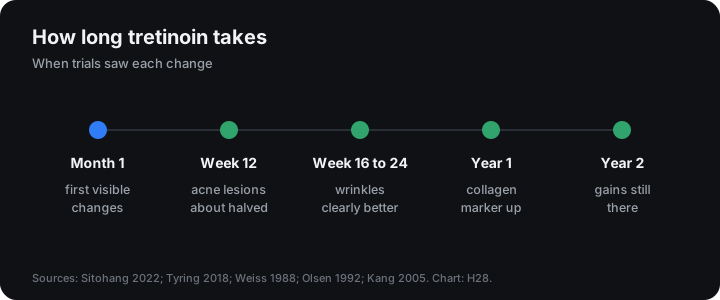
The longest trial ran two years with 204 people. Wrinkles, sun spots and sallow tone kept improving over placebo, biopsies showed no worrying cell changes, and a collagen-building marker rose by month 12 (Kang et al., 2005). A 2022 review of seven trials saw changes start in month one and hold to month 24 (Sitohang et al., 2022).
Acne, texture and pores
For breakouts, two pooled trials put 1,640 people on a 0.05% lotion for 12 weeks (Tyring et al., 2018). Red, inflamed spots fell 52% and blackheads and whiteheads 46%, though only 18% reached clear or almost clear. A review of 54 trials found every approved retinoid beat vehicle, with little to choose between them (Kolli et al., 2019).
Pores are where hype outruns data. A review of pore treatments lists retinoids as an option without trial numbers (Dong et al., 2016). Smoother texture, yes. Shrinking pores, unproven.
The purge, and why stronger isn’t better
No trial we read measured a “purge”. They measured irritation. In a veterans’ trial of the 0.1% cream, 61% reported redness, peeling or similar within six months (Pomerantz et al., 2014). People with a history of acne were less likely to react.
Stronger is mostly just angrier. At 48 weeks, 0.1% and 0.025% improved sun damage about equally, and the stronger cream irritated more (Griffiths et al., 1995). Too weak fails too: the two lowest doses in the 1992 trial matched plain cream.
Retinol, sun and pregnancy
Retinol, the shop-shelf precursor, is gentler. Over 24 weeks, 20 women on retinol blends did as well as those on 0.02% tretinoin, with redness in 11% against 64% (Chien et al., 2022). A 2024 review of 25 comparisons kept tretinoin as the standard; most rival studies were too weak to crown a replacement (Siddiqui et al., 2024).
Light breaks tretinoin down, UVA most of all, and that lab team suggested the breakdown may feed the drug’s sun sensitivity (Tashtoush et al., 2008). Tretinoin and tanning don’t mix; what UV alone does is in Tanmaxxing Bronzes the Face It Ages.
Pregnancy is the hard stop. Pooled data on 654 exposed pregnancies showed no clear rise in birth defects, yet the authors said that can’t justify use while pregnant (Kaplan et al., 2015). A 2026 analysis of eight studies agreed, noting one registry drove most of the result (Alali et al., 2026).
Before you buy a tube
Book a dermatologist. Ask whether tretinoin or something milder fits, list every product you use, and mention if pregnancy is possible. Then wear sunscreen daily and photograph your face by the same window each month.
FAQ
How long does tretinoin take to work? Breakouts need about three months. Fine lines and sun spots took four to six months in the trials, with gains still arriving in year two.
Is tretinoin better than retinol? Tretinoin has far more proof and stings more. For sensitive skin, retinol is a sensible first try that a small trial found about as effective.
Can tretinoin shrink pores? Nobody has shown it with numbers. Less clogged skin may make them look smaller, but that’s an impression, not a measurement.
References
- Weiss JS, Ellis CN, Headington JT, Tincoff T, Hamilton TA, Voorhees JJ. Topical tretinoin improves photoaged skin. A double-blind vehicle-controlled study. JAMA. 1988;259(4):527-32. PMID: 3336176. doi:10.1001/jama.1988.03720040019020
- Olsen EA, Katz HI, Levine N, et al. Tretinoin emollient cream: a new therapy for photodamaged skin. J Am Acad Dermatol. 1992;26(2 Pt 1):215-24. PMID: 1552056. doi:10.1016/0190-9622(92)70030-j
- Kang S, Bergfeld W, Gottlieb AB, et al. Long-term efficacy and safety of tretinoin emollient cream 0.05% in the treatment of photodamaged facial skin: a two-year, randomized, placebo-controlled trial. Am J Clin Dermatol. 2005;6(4):245-53. PMID: 16060712. doi:10.2165/00128071-200506040-00005
- Sitohang IBS, Makes WI, Sandora N, Suryanegara J. Topical tretinoin for treating photoaging: a systematic review of randomized controlled trials. Int J Womens Dermatol. 2022;8(1):e003. PMID: 35620028. doi:10.1097/JW9.0000000000000003
- Tyring SK, Kircik LH, Pariser DM, Guenin E, Bhatt V, Pillai R. Novel tretinoin 0.05% lotion for the once-daily treatment of moderate-to-severe acne vulgaris: assessment of efficacy and safety in patients aged 9 years and older. J Drugs Dermatol. 2018;17(10):1084-1091. PMID: 30365589.
- Kolli SS, Pecone D, Pona A, Cline A, Feldman SR. Topical retinoids in acne vulgaris: a systematic review. Am J Clin Dermatol. 2019;20(3):345-365. PMID: 30674002. doi:10.1007/s40257-019-00423-z
- Dong J, Lanoue J, Goldenberg G. Enlarged facial pores: an update on treatments. Cutis. 2016;98(1):33-6. PMID: 27529707.
- Pomerantz H, Weinstock MA; Veterans Affairs Topical Tretinoin Chemoprevention Trial Group. Predictors of local adverse effects caused by topical tretinoin cream 0.1% in the Veterans Affairs Topical Tretinoin Chemoprevention trial. Br J Dermatol. 2014;171(3):642-5. PMID: 24666361. doi:10.1111/bjd.12987
- Griffiths CE, Kang S, Ellis CN, et al. Two concentrations of topical tretinoin (retinoic acid) cause similar improvement of photoaging but different degrees of irritation. A double-blind, vehicle-controlled comparison of 0.1% and 0.025% tretinoin creams. Arch Dermatol. 1995;131(9):1037-44. PMID: 7544967. doi:10.1001/archderm.1995.01690210067011
- Chien AL, Kim DJ, Cheng N, et al. Biomarkers of tretinoin precursors and tretinoin efficacy in patients with moderate to severe facial photodamage: a randomized clinical trial. JAMA Dermatol. 2022;158(8):879-886. PMID: 35675051. doi:10.1001/jamadermatol.2022.1891
- Siddiqui Z, Zufall A, Nash M, et al. Comparing tretinoin to other topical therapies in the treatment of skin photoaging: a systematic review. Am J Clin Dermatol. 2024;25(6):873-890. PMID: 39348007. doi:10.1007/s40257-024-00893-w
- Tashtoush BM, Jacobson EL, Jacobson MK. UVA is the major contributor to the photodegradation of tretinoin and isotretinoin: implications for development of improved pharmaceutical formulations. Int J Pharm. 2008;352(1-2):123-8. PMID: 18093761. doi:10.1016/j.ijpharm.2007.10.045
- Kaplan YC, Ozsarfati J, Etwel F, Nickel C, Nulman I, Koren G. Pregnancy outcomes following first-trimester exposure to topical retinoids: a systematic review and meta-analysis. Br J Dermatol. 2015;173(5):1132-41. PMID: 26215715. doi:10.1111/bjd.14053
- Alali AB, Alhammad FA, Almohammed Saleh JA, et al. Topical retinoids and the risk of major congenital malformations and spontaneous abortion: a systematic review and meta-analysis. Front Drug Saf Regul. 2026;6:1864872. PMID: 42564875. doi:10.3389/fdsfr.2026.1864872
Cover: screenshot of a TikTok video, shared as commentary.