· H28 · Myths · 5 min read
Moon Face Is Real. Your Stress Week Isn't It.
A true cortisol face comes with a diagnosis. A puffy morning comes with a short night.


“Cortisol face” is real only in its medical form: the rounded “moon face” of Cushing syndrome, where cortisol stays far above normal for months. In those patients, 3D scans show extra fat packed into the cheeks and lower face. We found no study showing that everyday stress does the same to a healthy face; a round or puffy face is far more often body fat, fluid or a short night.
Verdict: Mostly myth.
The trend borrows a medical sign
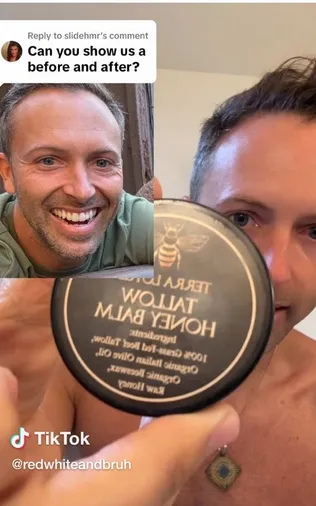
“Proof that stress LITERALLY changes your whole face,” reads the caption on a video by @hannahchengbradshaw with 3.3 million plays. Another creator’s clip, “Moon face is a real thing”, passed 23 million. The fix on offer is usually a cortisol cocktail, a supplement stack, or a “debloat” routine of cold water and face massage.
The phrase borrows a real medical sign and stretches it over any face that looks a bit fuller in a selfie.
You want a sharper, leaner face → you drink the cortisol mocktail and cut stress → the roundness was fat or fluid, not a hormone → what moves it is losing fat overall, sleeping enough, and a doctor if other symptoms show up.
What a real cortisol face looks like
Cushing syndrome means the body is flooded with cortisol for a long time, either from its own glands or from steroid medicine (Messina et al., 2009). A round “moon face” is one of its classic signs.
A 2026 study in Beijing took 3D face scans of 42 people with Cushing syndrome and compared them with 42 people with ordinary obesity, matched for age, sex and body mass index (Qiang et al., 2026). Same weight, different faces. The Cushing group carried much more fat in the cheeks and lower face, spreading both wider and deeper. Disease duration and cortisol levels were among the factors tied to it. A computer model sorted the two groups correctly 91.7% of the time.
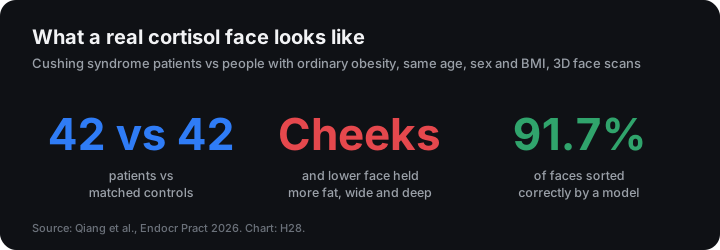
That’s what a cortisol face is: a measurable redistribution of fat under disease-level hormone levels, sustained for months or years.
Where the stress story breaks
Three things get blurred together online.
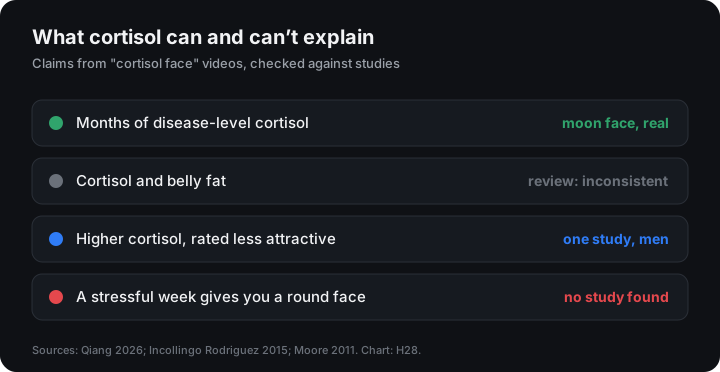
Stress hormone and body fat. A review of cortisol in obesity found a loose pattern, with more belly fat tied to a more reactive stress response, but also called the literature “inconclusive” and full of contradictions (Incollingo Rodriguez et al., 2015). If researchers can’t pin the link on the belly, a week of deadlines isn’t reshaping your cheeks.
Cortisol and attractiveness. One study did find that men with higher cortisol were rated less attractive, and that women preferred faces built from low-cortisol cues (Moore et al., 2011). That’s a correlation in male faces, measured with hormone samples, not proof that a stressful month rounds anyone’s face.
Morning puffiness. Swollen eyelids after a bad night are real, and strangers notice them. They’re fluid that fades within hours, as the sleep studies in [A Bad Week of Sleep Shows on Your Face] showed(/blog/beauty-sleep-science).
What rounds a face instead
Most often it’s body fat. The face gains and loses along with your body, and no massage or tea targets it alone; the evidence is in There Is No Exercise for Belly Fat.

What we’d actually do
- Lose fat the boring way. A steady calorie deficit moves the face along with everything else.
- Fix the week, not the morning. Several short nights show on the face; one doesn’t.
- Skip the cortisol supplements. Nothing in these studies tested them.
- Get checked if it’s more than your face. A moon face that arrives with other body changes, or while you’re on steroid tablets, is a reason to see a doctor, not a routine.
FAQ
Can stress make your face puffy? Not in any study we found for healthy people. A truly cortisol-rounded face comes with Cushing syndrome, a medical condition with other symptoms.
What is moon face? A rounded face caused by fat collecting around the cheeks and jaw, a classic sign of Cushing syndrome, including the kind triggered by long-term steroid medicine.
How do you get rid of a round face? If it’s body fat, lose fat overall; the face follows. If it appeared quickly with other symptoms, see a doctor.
References
- Qiang J, Liu R, Lu L, Long X, Pan H, Huang J, Chen S. The face of excess cortisol: clinical and morphologic insights into Cushing syndrome. Endocr Pract. 2026;32(3):318-328. PMID: 41167562. doi:10.1016/j.eprac.2025.10.012
- Messina MF, Valenzise M, Aversa S, Arrigo T, De Luca F. Iatrogenic Cushing syndrome caused by ocular glucocorticoids in a child. BMJ Case Rep. 2009;2009:bcr11.2008.1224. PMID: 21686405. doi:10.1136/bcr.11.2008.1224
- Incollingo Rodriguez AC, Epel ES, White ML, Standen EC, Seckl JR, Tomiyama AJ. Hypothalamic-pituitary-adrenal axis dysregulation and cortisol activity in obesity: a systematic review. Psychoneuroendocrinology. 2015;62:301-18. PMID: 26356039. doi:10.1016/j.psyneuen.2015.08.014
- Moore FR, Cornwell RE, Smith MJ, Al Dujaili EA, Sharp M, Perrett DI. Evidence for the stress-linked immunocompetence handicap hypothesis in human male faces. Proc Biol Sci. 2011;278(1706):774-80. PMID: 20843854. doi:10.1098/rspb.2010.1678
Cover: screenshot of a TikTok video, shared as commentary.