· H28 · Protocols · 5 min read
The Gym Beats Every Face Hack
Three lifting days, enough protein and a patient cut. The rest is marketing.

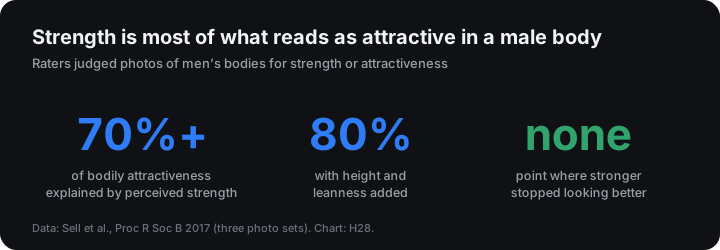
Lifting is the biggest looks lever most men never pull: in one study, how strong a man looked explained over 70% of how attractive his body was rated. Twelve weeks of three lifting days, about 1.6 g of protein per kilo, and a slow cut if you carry extra fat will change your frame and start revealing your face. None of it needs a supplement, a tongue trick or a hammer.
Verdict: Works.
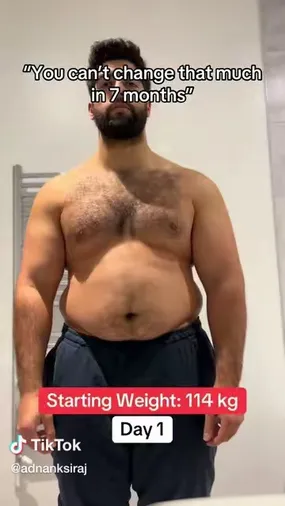
You’ve already watched the TikTok: day one at 114 kg, “you can’t change that much in 7 months”, then the reveal. Here’s what the research says a normal beginner can expect.
Why strength is the look
Researchers showed raters three sets of photos of men’s bodies. One group judged how strong each man looked, another judged how attractive he was (Sell et al., 2017).
Perceived strength accounted for more than 70% of attractiveness. Add height and leanness and it reached 80%. And there was no tipping point: in every sample, the strongest-looking men were rated the most attractive.
You want to look better → you chase face tricks and supplements → nothing moves, because shoulders and body fat do most of the talking → three months of lifting and eating right move both.
Train: volume is the dial
Muscle grows with the amount of hard work you give it. A meta-analysis of 15 studies found a clear dose-response: each extra weekly set added about 0.37% to muscle gain, and higher-volume programs grew about 3.9 percentage points more muscle than lower-volume ones (Schoenfeld et al., 2017).
For a beginner that means three full-body sessions a week, the big lifts (a squat, a hinge, a press, a pull), and working up to about ten hard sets per muscle a week. Add a little weight or a rep most weeks. Early strength comes fast, which is what keeps people coming back.
Eat: protein has a ceiling
Across 49 randomized trials with 1,863 people, protein on top of lifting added muscle and strength. The benefit flattened out at 1.62 g per kilo of bodyweight a day; more than that bought nothing extra (Morton et al., 2018).
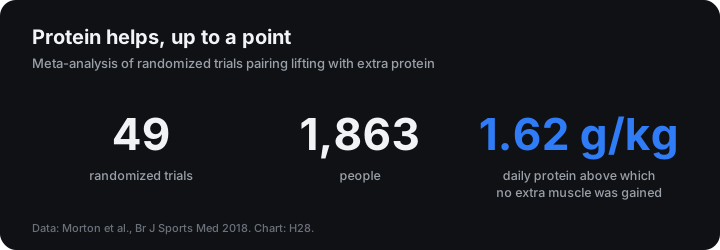
For an 80 kg man that’s around 130 g a day. Meat, fish, eggs, dairy, legumes, and a shake if the numbers don’t add up. The meta-analysis also found protein helps less as you age, which is one more reason to start now.
Cut slowly, or lose the muscle you built
If you’re carrying extra fat, the face changes once you drop it. Fat comes off in your body’s own order, so crunches won’t speed up the stomach (there is no exercise for belly fat), and your jaw follows your total body fat (face yoga made their cheeks fuller).
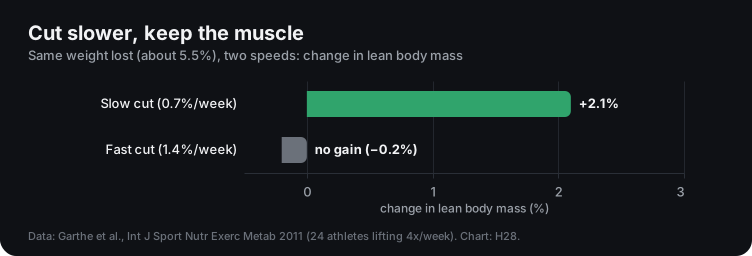
Speed matters. Athletes who lifted four times a week lost the same 5.5% of bodyweight at two speeds. The slow group, losing 0.7% a week, added 2.1% lean mass and burned more fat along the way. The fast group, at 1.4% a week, kept its lean mass flat (Garthe et al., 2011).
Protein matters more in a deficit. Young men on a hard 4-week cut who ate 2.4 g/kg added 1.2 kg of muscle and other lean tissue while losing 4.8 kg of fat, against 0.1 kg and 3.5 kg on 1.2 g/kg (Longland et al., 2016).
The 12-week plan
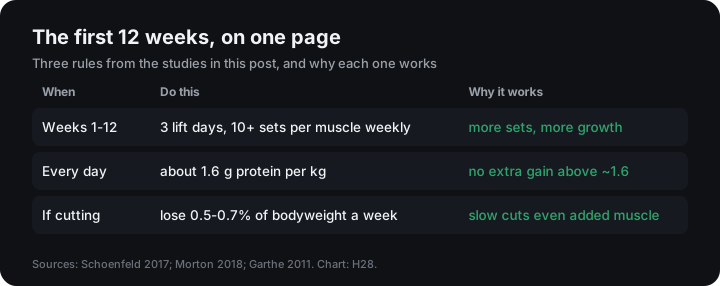
- Weeks 1 to 4: learn the lifts, three days a week, and hit your protein. Take photos in the same light on day one.
- Weeks 5 to 8: keep adding load. If you’re cutting, trim portions so the scale drops about half a percent a week.
- Weeks 9 to 12: same plan, more weight. Compare photos, not mirrors.
FAQ
How long until lifting changes how I look? Strength climbs within weeks. Visible change to your shape and face usually takes a few months of steady training and, if needed, a patient cut.
How much protein do I need to build muscle? Roughly 1.6 g for every kilo you weigh, daily. The biggest analysis found no extra muscle above that.
Should I bulk or cut first as a beginner? If there’s noticeable fat to lose, cutting slowly while you lift can still add muscle. Aim to drop 0.5 to 0.7% of your weight each week.
References
- Sell A, Lukazsweski AW, Townsley M. Cues of upper body strength account for most of the variance in men’s bodily attractiveness. Proc Biol Sci. 2017;284(1869):20171819. PMID: 29237852. doi:10.1098/rspb.2017.1819
- Schoenfeld BJ, Ogborn D, Krieger JW. Dose-response relationship between weekly resistance training volume and increases in muscle mass: a systematic review and meta-analysis. J Sports Sci. 2017;35(11):1073-82. PMID: 27433992. doi:10.1080/02640414.2016.1210197
- Morton RW, Murphy KT, McKellar SR, et al. A systematic review, meta-analysis and meta-regression of the effect of protein supplementation on resistance training-induced gains in muscle mass and strength in healthy adults. Br J Sports Med. 2018;52(6):376-84. PMID: 28698222. doi:10.1136/bjsports-2017-097608
- Garthe I, Raastad T, Refsnes PE, Koivisto A, Sundgot-Borgen J. Effect of two different weight-loss rates on body composition and strength and power-related performance in elite athletes. Int J Sport Nutr Exerc Metab. 2011;21(2):97-104. PMID: 21558571. doi:10.1123/ijsnem.21.2.97
- Longland TM, Oikawa SY, Mitchell CJ, Devries MC, Phillips SM. Higher compared with lower dietary protein during an energy deficit combined with intense exercise promotes greater lean mass gain and fat mass loss: a randomized trial. Am J Clin Nutr. 2016;103(3):738-46. PMID: 26817506. doi:10.3945/ajcn.115.119339
Cover: screenshot of a TikTok video, shared as commentary.