· H28 · Protocols · 5 min read
Your Body Clock Runs Late. Here's a 7-Day Reset
Hours matter less than you think if they land at the wrong time of night.


You reset your body clock with light and timing, and more hours in bed won’t do it alone. Get outside within an hour of waking, keep one wake time on all seven days, and dim your evenings. In field studies, seven days of this pulls the clock earlier, and even a weekend of real daylight gets you most of the way.
Verdict: Works, for the clock. Your face gets the benefit second-hand, through better sleep.
Someone on TikTok made their boyfriend stand in the driveway with his “thyroid to the sun.” The pose is silly. The instinct behind it, morning light, is the most solid part of the whole sleepmaxxing trend.
Why your clock drifts
Your brain keeps a roughly 24-hour clock, and it sets itself mostly by light. Bright morning light pulls it earlier. Evening light from lamps and screens pushes it later.
Modern life gets both backwards. Indoors all day, you get far less daylight than your clock expects. Awake at night under lights, you get more light than it expects. The result is a body that thinks it’s earlier than it is.
You want to look rested → you sleep 8 hours from 2 to 10 on weekends and 12 to 7 on weekdays → your clock can’t settle and your sleep lands in the wrong part of its night → you wake up tired no matter the hours, so you add a supplement instead of a wake time.
The camping experiment
Researchers at the University of Colorado took people camping with no electric light at all, and measured their melatonin before and after (Wright et al., 2013).
At home, surrounded by electric light, their internal clocks ran late. After a week outdoors, the body’s night began at sunset and ended shortly after sunrise. The latest night owls shifted the most.
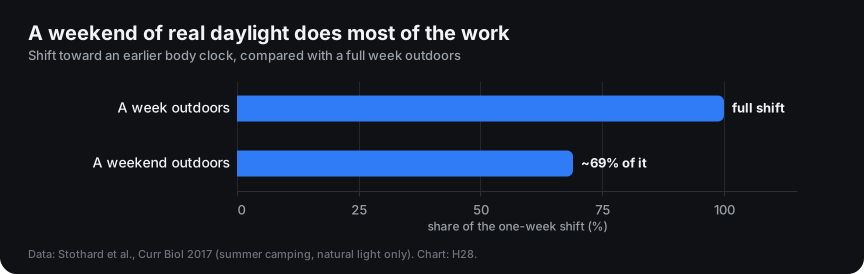
A follow-up found you don’t need a full week. A single weekend of summer camping produced about 69% of the shift a whole week did (Stothard et al., 2017).
Irregular sleep, late clock
Timing matters as much as light. A Harvard team followed 61 students for 30 days and scored how regular their sleep was (Phillips et al., 2017).
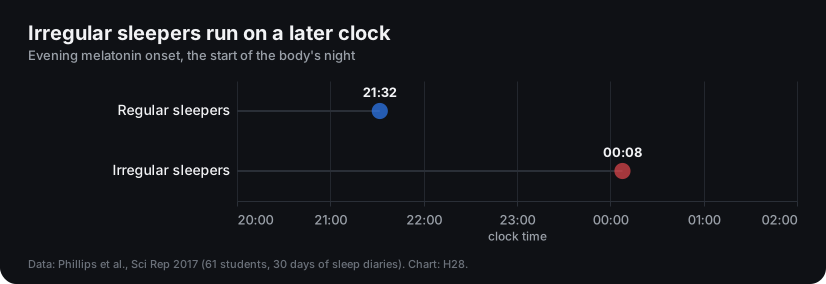
The most irregular sleepers had a body clock running about two and a half hours behind the regular ones. Their melatonin rose at 8 minutes past midnight instead of 9:32 in the evening. Their days were also dimmer: their daytime light peaked around 102 lux against 179 for regular sleepers.
The weekend problem
Sleeping in on Saturday feels like catching up. To your clock it’s a flight to another time zone, and back again on Monday. Researchers call the gap between workday and free-day sleep “social jetlag.”
In a survey of 501 people, late types carried the biggest gap and the most sleep debt on workdays, and social jetlag went with lower wellbeing and more caffeine, nicotine and alcohol, most strongly in people up to 25 (Wittmann et al., 2006). A later large study linked social jetlag with a higher BMI, beyond how long people slept (Roenneberg et al., 2012).
Your screen at night
The light that shifts your clock is mostly the blue-heavy kind. In a lab study, 72 men used screens four hours before bed at settings with more or less of that light (Schöllhorn et al., 2023).
With less of it, they fell asleep faster, their melatonin was suppressed less and their melatonin onset came earlier, and the effect scaled with the dose. Night mode, which cuts that part of the light, does something measurable.
The 7-day reset
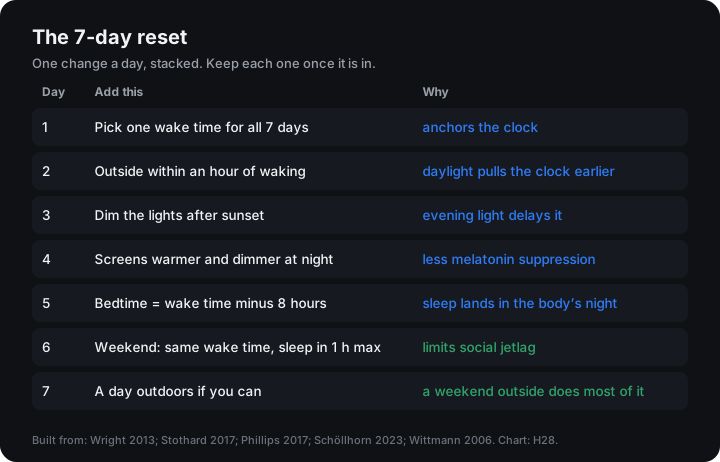
Add one change a day and keep the ones before it. By day seven you’re running the whole routine. The anchor is the wake time: it’s easier to control than when you fall asleep, and the rest organizes around it.
Once your clock and your schedule agree, the sleep you get counts for more. That’s where the face comes in, and we covered what a run of bad nights does to it in a bad week of sleep shows on your face.
FAQ
How long does it take to reset your circadian rhythm? Outdoors, one week lined the clock up with sunrise and sunset, and a weekend did about 69% of that.
Is morning sunlight better than a light box? The research here used real daylight, so that’s the version with evidence behind it. Getting outside is free, and it’s what was tested.
Can I sleep in on weekends? Keep it to about an hour. A bigger swing between weekdays and weekends is social jetlag, which pushes your clock later again.
References
- Wright KP Jr, McHill AW, Birks BR, et al. Entrainment of the human circadian clock to the natural light-dark cycle. Curr Biol. 2013;23(16):1554-8. PMID: 23910656. doi:10.1016/j.cub.2013.06.039
- Stothard ER, McHill AW, Depner CM, et al. Circadian entrainment to the natural light-dark cycle across seasons and the weekend. Curr Biol. 2017;27(4):508-13. PMID: 28162893. doi:10.1016/j.cub.2016.12.041
- Phillips AJK, Clerx WM, O’Brien CS, et al. Irregular sleep/wake patterns are associated with poorer academic performance and delayed circadian and sleep/wake timing. Sci Rep. 2017;7(1):3216. PMID: 28607474. doi:10.1038/s41598-017-03171-4
- Wittmann M, Dinich J, Merrow M, Roenneberg T. Social jetlag: misalignment of biological and social time. Chronobiol Int. 2006;23(1-2):497-509. PMID: 16687322. doi:10.1080/07420520500545979
- Roenneberg T, Allebrandt KV, Merrow M, Vetter C. Social jetlag and obesity. Curr Biol. 2012;22(10):939-43. PMID: 22578422. doi:10.1016/j.cub.2012.03.038
- Schöllhorn I, Stefani O, Lucas RJ, et al. Melanopic irradiance defines the impact of evening display light on sleep latency, melatonin and alertness. Commun Biol. 2023;6(1):228. PMID: 36854795. doi:10.1038/s42003-023-04598-4
Cover: screenshot of a TikTok video, shared as commentary.