· H28 · Myths · 6 min read
Bonesmashing: Put the Hammer Down
What Wolff’s law really says, and what a hammer does to the thin bones under your eyes.

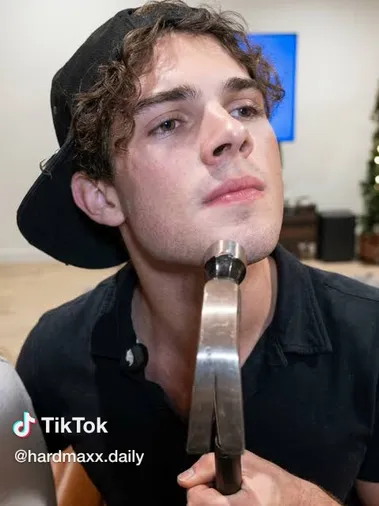
At some point in 2026 you watched a guy tap his cheekbones with a hammer on a livestream, and a small part of your brain went: wait, does that work?
No. Bone gets bigger when muscles load it thousands of times over years. A hammer injures bone instead, and the thin bones of your midface answer injury by cracking, shifting and pinching the nerves that run through them.
Verdict: Dangerous.
How a joke became a tutorial
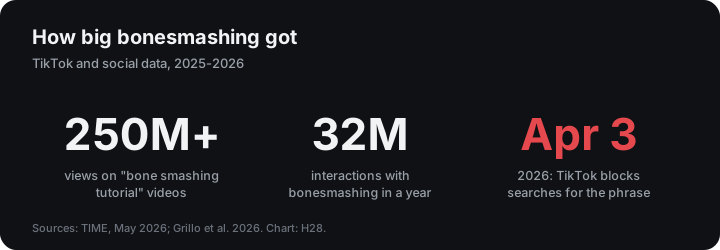
Bonesmashing started as a troll on incel forums, according to Rolling Stone, and TikTok took it literally. By early 2026 “bone smashing tutorial” videos had passed 250 million views, and TikTok moved on April 3 to block searches for the phrase (TIME). Try it today and you get nothing.
It moved to livestreams and X instead, where a clip of streamer Clavicular describing his mom confiscating his hammer pulled 14 million views. The most honest reply under all of it, with 15,000 likes: “Is there any actual proof of the bonesmashing shit actually working or is he just hitting himself with a hammer for no reason?”
Here’s the loop:
You want higher cheekbones → you tap them every morning → you get bruising, maybe a hairline crack in a bone that’s paper-thin → it heals back where it was, or slightly wrong, and sometimes the numbness stays.
The argument, at its best
One post with 1.9 million views makes the believers’ case: fighters have thick knuckles, tennis players have a thick forearm on their hitting side. Bone responds to stress. So stress your face.
The tennis part is true. Players’ racket arms carry bones with 16 to 21% more cross-sectional area and a strength index up to 37% higher than their other arm (Haapasalo et al., 2000).
Look at how they got there, though. Years of hard, repeated muscle pull on the same bone, week after week, never enough to break it. That’s the modern version of Wolff’s law, which bone researcher Harold Frost called the mechanostat: bone reads the strain that muscles put on it and adds or removes material to match (Frost, 2004).
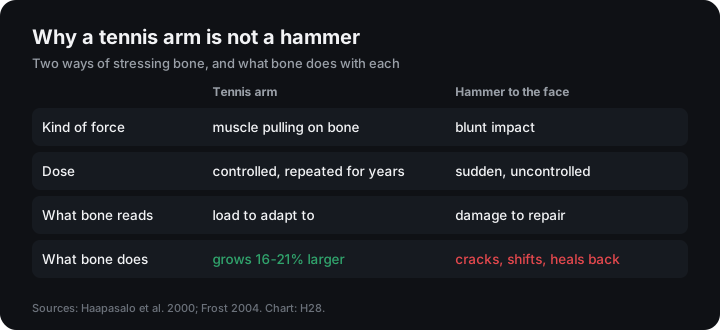
A hammer sends a different signal: one sudden impact, which at the forces people use registers as damage.
What a blow does to a cheekbone
Your cheekbone (the zygoma) is a thin strut. Right under it sit the eye socket and a hollow sinus, and a nerve runs through a small hole below the eye carrying feeling to your cheek, upper lip and side of the nose.
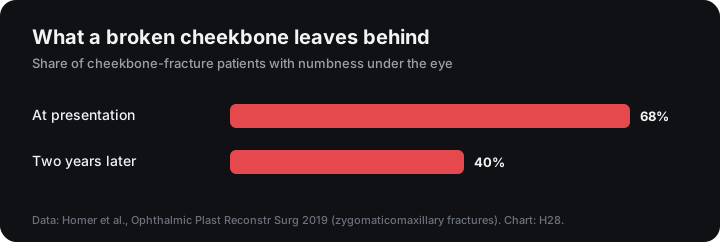
Hit that area hard enough and the zygoma can crack or shift. Surgeons see this every day from fights and falls, and the numbers aren’t subtle. In one follow-up study, 68% of patients with a cheekbone fracture had numbness under the eye, and two years later 40% still did (Homer et al., 2019).
Even when a crack heals cleanly, healing doesn’t hand out extra bone for your trouble. The body repairs the break and remodels toward the shape it had. A piece that heals crooked stays crooked, and fixing it means a surgeon.
Maxillofacial surgeons have been warning about this in their journals since 2024 (Grillo, 2024; Pacquelet et al., 2024), and a 2026 analysis tracked about 32 million interactions with bonesmashing content in a single year (Grillo et al., 2026).
The swelling illusion
Swelling. A bruised face puffs up for days, and a puffed cheekbone looks higher in a mirror. Add a leaner week, better lighting and a chin tilt, and you have a transformation that goes away before the next scan.
Before you pick up a hammer
- Put the hammer down. There’s no dose of this that builds bone.
- Drop some body fat. Cheekbones mostly hide under fat, and losing it shows the ones you have.
- Use hair and light. A haircut with volume on the sides and overhead light both change how prominent cheekbones read in photos.
- Want real change? Cheek implants and fillers exist and surgeons place them safely. Talk to one.
- Already did it? A numb cheek, double vision or a bite that suddenly feels off means an ER or a maxillofacial surgeon, today.
FAQ
Is bonesmashing the same as Wolff’s law? No. Wolff’s law describes bone adapting to repeated loading from muscles and movement. It says nothing good about blunt trauma.
Do fighters’ knuckles prove it works? Fighters train for years with controlled loading, and a lot of what looks like bigger knuckles is thickened skin, scar tissue and joint damage. It’s not a cosmetic result anyone plans for.
Is light tapping safe? If a tap can’t injure bone, it can’t change it either. There’s no zone where it’s both safe and useful.
References
- Frost HM. A 2003 update of bone physiology and Wolff’s Law for clinicians. Angle Orthod. 2004;74(1):3-15. PMID: 15038485. doi:10.1043/0003-3219(2004)074<0003:AUOBPA>2.0.CO;2
- Haapasalo H, Kontulainen S, Sievänen H, et al. Exercise-induced bone gain is due to enlargement in bone size without a change in volumetric bone density: a peripheral quantitative computed tomography study of the upper arms of male tennis players. Bone. 2000;27(3):351-7. PMID: 10962345. doi:10.1016/s8756-3282(00)00331-8
- Homer N, Glass LR, Lee NG, et al. Assessment of infraorbital hypesthesia following orbital floor and zygomaticomaxillary complex fractures using a novel sensory grading system. Ophthalmic Plast Reconstr Surg. 2019;35(1):53-5. PMID: 29975327. doi:10.1097/IOP.0000000000001162
- Grillo R. Urgent concern regarding “bone smashing”, a dangerous trend on TikTok. J Stomatol Oral Maxillofac Surg. 2024;125(2):101783. PMID: 38278441. doi:10.1016/j.jormas.2024.101783
- Pacquelet E, Bon L, Essid L, Guillier D. The bone smashing and the excesses of social networking trends. J Stomatol Oral Maxillofac Surg. 2024;125(12 Suppl 2):101814. PMID: 38458546. doi:10.1016/j.jormas.2024.101814
- Grillo R, Fernandes LA, Rodrigues Dos Santos LA, et al. Dangerous trends on social media related to facial esthetics: analysis of looksmaxxing, softmaxxing and hardmaxxing practices. J Stomatol Oral Maxillofac Surg. 2026;127(5):102971. PMID: 42674114. doi:10.1016/j.jormas.2026.102971
- Face value: why looksmaxxing is more than mewing. TIME, 2 May 2026. time.com
Cover: screenshot of a TikTok video, shared as commentary.