· H28 · Myths · 5 min read
That Selfie Face Only Exists Up Close
The mirror, the phone, and a portrait at five feet are three different faces.

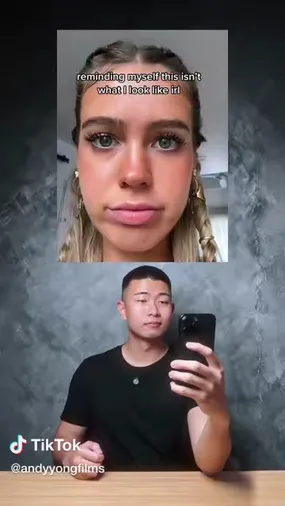
Yes, a selfie at arm’s length makes your nose look bigger than it is. Up close, your nose sits much nearer the lens than your cheeks and ears, so the camera enlarges it: a geometry study put the effect at about 30% at one foot away. From five feet the distortion disappears, which is why the mirror and a friend’s photo look like a different person.
Verdict: Real. The selfie is the distorted one, not your face.
You opened the front camera, hated your nose, then walked past the bathroom mirror and looked normal. Both of those were accurate. They were measuring from different distances.
Nobody likes selfies anyway
In a survey of 238 people, 82% said they’d rather see other kinds of photos than selfies on social media (Diefenbach and Christoforakos, 2017). The dislike has a physical cause, and it’s the same reason your own selfies feel wrong: the camera sits too close to your face.
What a foot of distance does
Surgeons at Rutgers built a mathematical model of the average face to measure how camera distance changes it (Ward et al., 2018). Your nose sticks out in front of your cheeks, so when the phone is close, the nose takes up a bigger share of the frame than it does in real life.
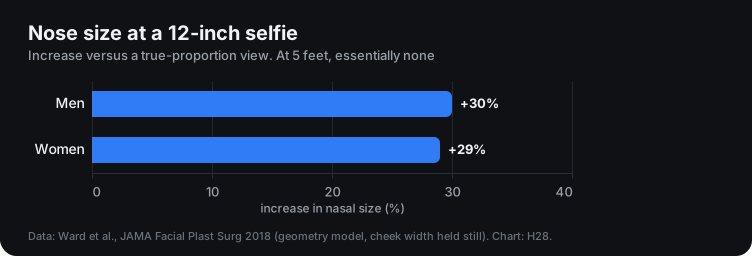
At 12 inches, a typical selfie distance, the model put the nose about 30% wider in men and 29% wider in women than an undistorted view. At 5 feet, the difference was gone.
You want a smaller nose → you judge it from the phone at arm’s length → the lens enlarges whatever sits nearest to it → you blame your face for what the camera did.
What real selfies show
A model is one thing, so another team tested 30 volunteers. Each took front-camera selfies at 12 and 18 inches, then had a clinical photo taken from 5 feet with a professional camera (Pressler et al., 2022).
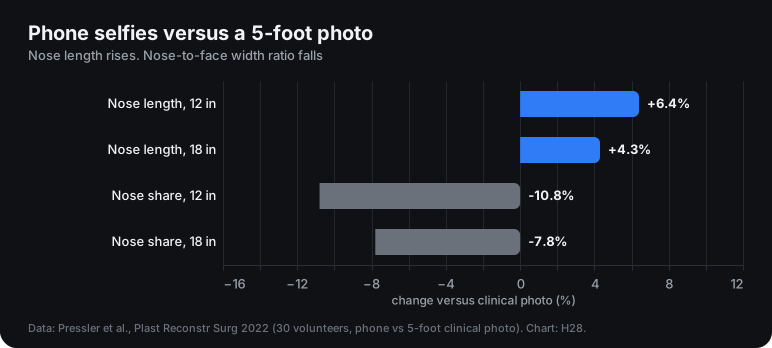
The 12-inch selfies made the nose 6.4% longer than the clinical photo, and the 18-inch ones 4.3% longer. Real faces don’t hold still in the frame the way the model assumes: the whole face shifts, and in these photos the nose ended up a smaller share of face width up close, not a bigger one. Either way, the selfie redraws the proportions.
It isn’t just phones. In another study of 12 people, a phone at 8 inches stretched the middle of the face vertically by 18%, and a full-frame camera from the same 8 inches stretched it by 12% to 19% (Derakhshan et al., 2024). Distance is the problem, whatever the camera.
Why you prefer the mirror
The mirror adds its own twist: it flips you. Faces aren’t symmetrical, so an ordinary photo shows an arrangement that feels unfamiliar.
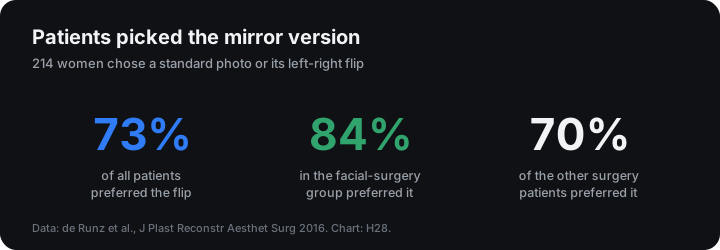
A French study asked 214 women, the day before plastic surgery, to choose between a normal photo of themselves and a mirrored one (de Runz et al., 2016). 73% picked the mirrored version. For those booked for facial cosmetic surgery, it rose to 84%.
So the phone and the mirror each distort you differently. One is too close. The other is backwards. Neither is how people see you.
How to see your real face
- Step back. Use the rear camera from about 5 feet, or have someone take the photo.
- Zoom instead of moving closer. A 2x or 3x lens from farther away keeps proportions honest.
- Flip it if you like. Mirroring a photo shows you the face you’re used to seeing.
- Decide nothing from a selfie. If a feature bothers you, check it in a distance shot first. Surgeons do.
FAQ
Do selfies make your nose look bigger? They do. Held close, the phone exaggerates whatever is closest, and for most faces that’s the nose. Shot from across a room, proportions return to normal.
What distance gives the most accurate photo of your face? Around five feet, which is the standard for clinical photos. If you want a tighter frame, zoom in rather than moving closer.
Why do I look better in the mirror than in photos? Familiarity. The mirror shows you a flipped face you’ve looked at for years, so an unflipped picture feels slightly off even when it’s accurate.
References
- Diefenbach S, Christoforakos L. The selfie paradox: nobody seems to like them yet everyone has reasons to take them. Front Psychol. 2017;8:7. PMID: 28144225. doi:10.3389/fpsyg.2017.00007
- Ward B, Ward M, Fried O, Paskhover B. Nasal distortion in short-distance photographs: the selfie effect. JAMA Facial Plast Surg. 2018;20(4):333-5. PMID: 29494735. doi:10.1001/jamafacial.2018.0009
- Pressler MP, Kislevitz ML, Davis JJ, Amirlak B. Size and perception of facial features with selfie photographs, and their implication in rhinoplasty and facial plastic surgery. Plast Reconstr Surg. 2022;149(4):859-67. PMID: 35139046. doi:10.1097/PRS.0000000000008961
- Derakhshan A, Gadkaree SK, Barbarite ER, et al. Quantifying facial distortion in modern digital photography. Laryngoscope. 2024;134(3):1234-8. PMID: 37543968. doi:10.1002/lary.30935
- de Runz A, Boccara D, Chaouat M, et al. Female plastic surgery patients prefer mirror-reversed photographs of themselves: a prospective study. J Plast Reconstr Aesthet Surg. 2016;69(1):122-7. PMID: 26428387. doi:10.1016/j.bjps.2015.08.023
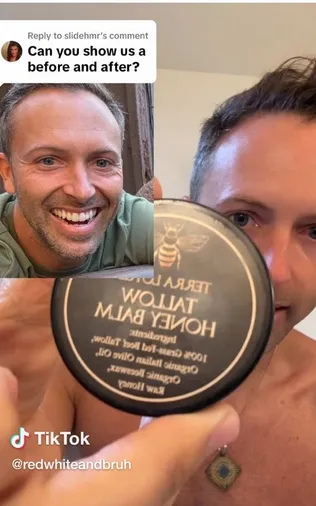
Cover: screenshot of a TikTok video, shared as commentary.