· H28 · Myths · 5 min read
The Golden Ratio Lost to the Average Face
The most attractive spacing turned out to be the ordinary one.


No, attractive faces aren’t built on the golden ratio. When researchers moved people’s eyes and mouths around to find the best-rated layout, it landed on the spacing of an average face, not on 1.618. A 2024 clinical review went further: it found nothing solid tying phi to beauty at all.
Verdict: Doesn’t work as a beauty standard.
The TikTok on the cover calls Leonardo DiCaprio’s face “perfect”, and somewhere under the comments a golden-ratio app is scoring yours. Here’s why that score means less than it looks.
Where the golden ratio pitch comes from
Phi is 1.618, the proportion behind the famous spiral. In the 2000s a surgeon named Stephen Marquardt drew a face-shaped mask out of it and presented it as the ideal human face. Plenty of people bought it, cosmetic surgeons included (Holland, 2008). Today it lives on as “golden ratio face” filters and calculators.
You want a perfect face → you run a selfie through a phi app and chase a better match → the app measures you against a proportion raters don’t reward → you spend effort on a ruler instead of on the things that move how you look.
The layout people rate highest
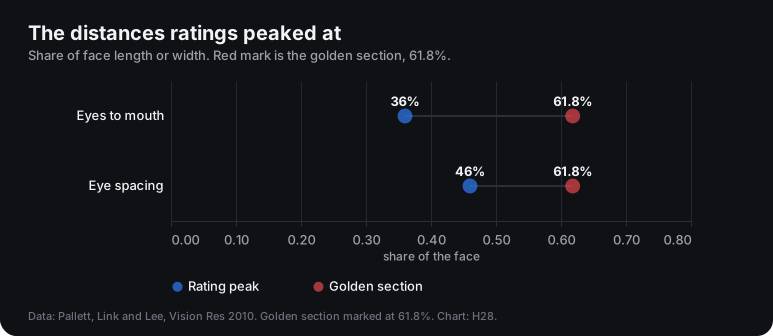
A team at UC San Diego and the University of Toronto tested it directly. Across four experiments, people compared versions of the same face where only two things changed: how far the eyes sat from the mouth, and how far apart the eyes were (Pallett et al., 2010).
Each face had a sweet spot: an eyes-to-mouth distance near 36% of face length, and eye spacing near 46% of face width. That is how an average face is laid out. Neither is the golden ratio.
Who the phi mask fits
When Holland checked the Marquardt mask against real faces with a proper shape analysis, it matched one narrow group best: white female fashion models with fairly masculine features. It fit poorly on sub-Saharan African and East Asian faces.
There’s a twist for women. Most people prefer more femininity in a woman’s face than the mask has, so aiming at a closer fit would move a face in the direction raters like less (Holland, 2008).

Nineteen golden proportions, four that mattered
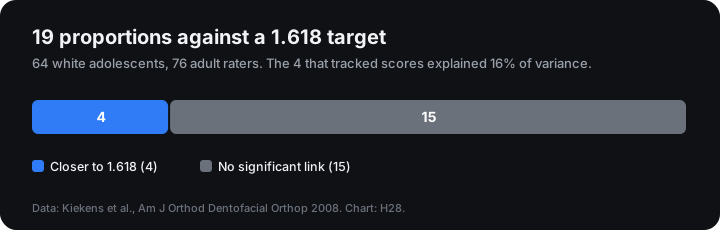
Orthodontics inherited a list of 19 “golden proportions” for the face. Dutch researchers measured all 19 on photos of 64 teenagers and had 76 adults rate how good each face looked (Kiekens et al., 2008).
Only 4 of the 19 lined up with the ratings, and jointly they accounted for just 16% of the spread in scores, which the authors called too small to matter clinically. The other 15 had no measurable link.
What does predict attractiveness
Averageness keeps coming out on top. When faces are nudged halfway toward their group’s average, adults prefer them, and so do children as young as five (Vingilis-Jaremko and Maurer, 2013). In a study of 96 faces rated by 114 people, averageness raised scores for both men and women, while symmetry helped only the male faces, and only a little (Komori et al., 2009).
A 2025 analysis tested the usual suspects side by side. Averageness still predicted attractiveness for both sexes and femininity predicted it for women. Symmetry and male masculinity added nothing once the rest was accounted for (Lee et al., 2025).
“Average” here doesn’t mean plain. It means features in typical proportion to each other, which is exactly what phi apps miss.
What to do instead
Delete the phi app. If a clinic pitches the golden ratio as a surgical blueprint, that’s a red flag: the 2024 review found no evidence for using it to plan facial surgery (Naini, 2024).
The changes that show on a face come from body fat, training and sleep. Start with the gym beats every face hack, then face yoga made their cheeks fuller and a bad week of sleep shows on your face.
FAQ
Is the golden ratio the key to an attractive face? No. In rating experiments the most attractive arrangement of eyes and mouth matched a typical face, and reviews of the evidence find no real link between phi and beauty.
Are golden ratio face apps accurate? They can measure your features precisely, but the target they compare you with barely predicts how people rate faces. Most golden proportions tested on real faces showed no link to attractiveness.
Should surgery be planned around the golden ratio? No. No study supports using phi to plan jaw or cosmetic face surgery, or to judge how it turned out. A surgeon who sells it as the blueprint is selling a myth.
References
- Pallett PM, Link S, Lee K. New “golden” ratios for facial beauty. Vision Res. 2010;50(2):149-154. PMID: 19896961. doi:10.1016/j.visres.2009.11.003
- Holland E. Marquardt’s Phi mask: pitfalls of relying on fashion models and the golden ratio to describe a beautiful face. Aesthetic Plast Surg. 2008;32(2):200-208. PMID: 18175168. doi:10.1007/s00266-007-9080-z
- Kiekens RM, Kuijpers-Jagtman AM, van ‘t Hof MA, van ‘t Hof BE, Maltha JC. Putative golden proportions as predictors of facial esthetics in adolescents. Am J Orthod Dentofacial Orthop. 2008;134(4):480-483. PMID: 18929264. doi:10.1016/j.ajodo.2006.10.041
- Naini FB. The golden ratio-dispelling the myth. Maxillofac Plast Reconstr Surg. 2024;46(1):2. PMID: 38228978. doi:10.1186/s40902-024-00411-2
- Vingilis-Jaremko L, Maurer D. The influence of averageness on children’s judgments of facial attractiveness. J Exp Child Psychol. 2013;115(4):624-639. PMID: 23708730. doi:10.1016/j.jecp.2013.03.014
- Komori M, Kawamura S, Ishihara S. Averageness or symmetry: which is more important for facial attractiveness? Acta Psychol (Amst). 2009;131(2):136-142. PMID: 19394585. doi:10.1016/j.actpsy.2009.03.008
- Lee P, Li J, Rafiee Y, Jones BC, Shiramizu VKM. Further evidence that averageness and femininity, rather than symmetry and masculinity, predict facial attractiveness judgments. Sci Rep. 2025;15(1):5498. PMID: 39953080. doi:10.1038/s41598-025-86974-0
Cover: screenshot of a TikTok video, shared as commentary.